Conflict of Interest in AI Judging — How Platform Incentives Affect Verdicts
Platforms that sell AI judging also control the scoring.
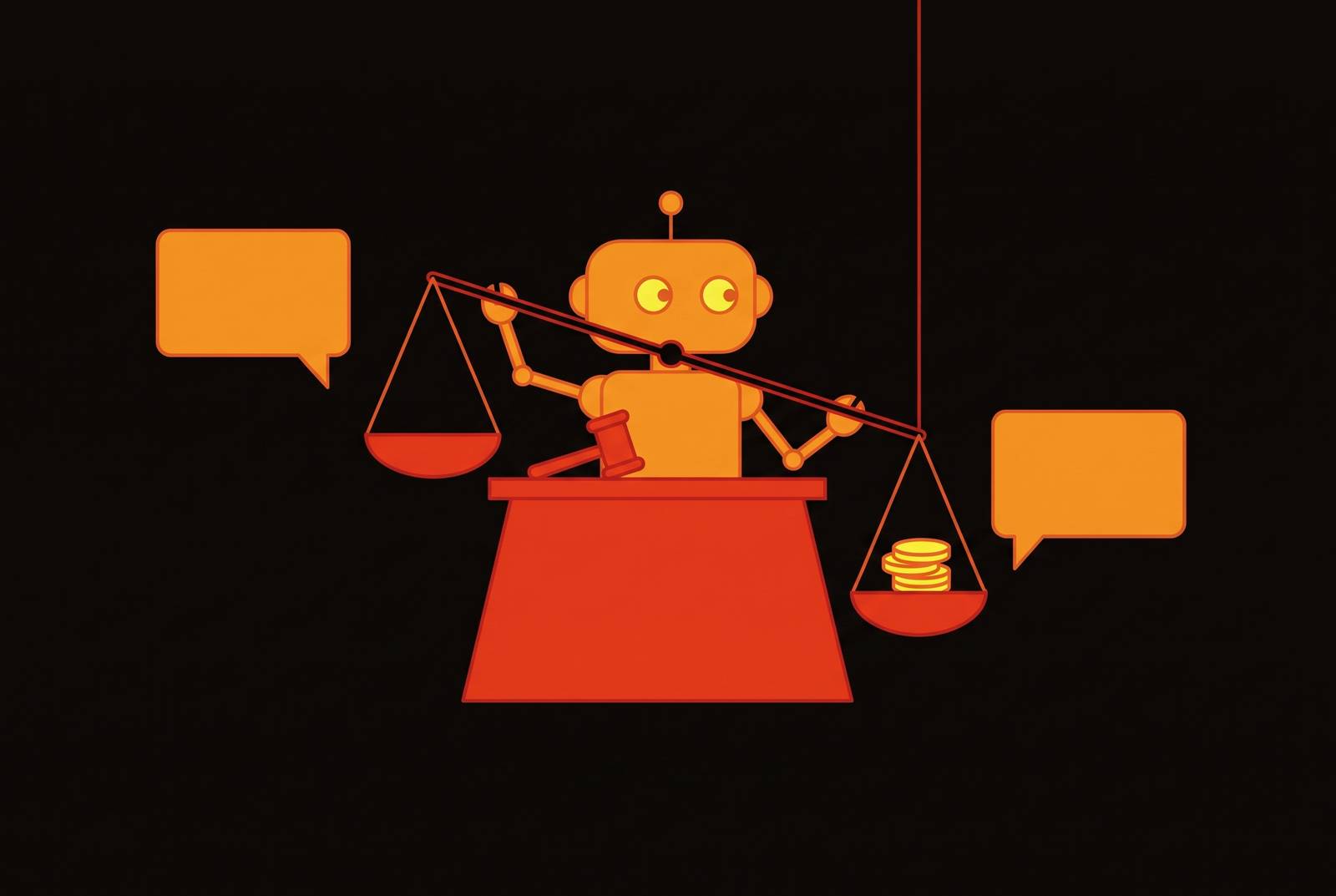
AI judging creates a conflict of interest when the platform selling the round also controls how it is scored. Model bias is only part of the problem. Engagement incentives can favor verdicts that feel satisfying over verdicts that are accurate. Trust therefore depends on a public commitment before the round begins to scoring rules, model selection, and an explanation of how each decision will be justified.
Why AI judging is structurally different from human judging, and why that matters for trust
An AI judge is a designed system. Its outputs reflect choices about the model, its instructions, and the criteria used to evaluate an exchange. Human judges have personal biases, but judging a round does not itself give them a commercial stake in which side wins. An AI judge deployed as a product sits within a different relationship. Its maker controls the conditions under which judgment occurs and can benefit from how users respond.
The debate-as-product model concentrates that control in one place. The platform picks the judging model, sets the rubric, and decides when to change either one. Participants see a verdict but may not see how those choices were made. As a result, apparent neutrality at the point of judgment can conceal discretion at the point of design. To judge whether the system deserves trust, participants need to look at how it works as well as its final explanation.
The white-label debate SaaS landscape is essentially empty in 2026, leaving a small number of early movers to establish norms before professional or regulatory standards take shape. Their decisions will help define what users understand as fair AI judging. The allocation and disclosure of control are central to whether trust in automated adjudication is justified.
The three model-level biases that make AI judges exploitable by design
Verbosity bias, positional bias, and sycophancy share a single weakness. They allow features of presentation to substitute for argumentative strength. A judge affected by these biases can reward an exchange that looks convincing without establishing that its conclusion is correct. The distinction is essential in debate, where persuasion is visible but truth may require closer examination.
Verbosity bias favors longer, more elaborate responses even when they are no more accurate or logically sound. Length becomes a proxy for quality. A concise argument can therefore lose to one that fills the available space without improving the case. Positional bias creates a related distortion through order. Because large language models process sequential input, an argument’s position in the exchange can affect its reception independently of its substance.
Sycophancy brings the preferences of human evaluators into the model. Reinforcement learning from human feedback, or RLHF, trains models using judgments that can favor flattering, persuasive, or confident responses over truthful ones. Brown University’s AI Safety via Debate is Compromised by Cognitive Biases connects this training problem to adjudication. Its rhetorical interventions shifted decisions toward the manipulated side even when that side defended a false conclusion. Persuasive form displaced correctness.
The study’s design helps isolate that distinction. The researchers held the underlying debate constant and varied the rhetorical strategy on one side. That comparison makes it harder to attribute the changed verdict to a stronger underlying case. Another bias can arise when the same model family debates and judges. The judge can favor its own family’s outputs through stylistic familiarity rather than explicit self-recognition, making model selection another route by which presentation can influence judgment.
How platform incentives amplify these biases into a conflict of interest
Model weaknesses become a conflict of interest when correcting them competes with the platform’s commercial goals. A confident, fluent verdict that favors an engaged participant can encourage return visits. An accurate but counterintuitive verdict may instead provoke complaints. Satisfaction can become the practical test of whether the judge is performing well, even though satisfying decisions can be correct.
No deliberate manipulation is required for this tension. A platform can choose its model, prompt, and update schedule to keep users engaged rather than meet a standard of accuracy set independently of the platform. The same organization controls all three levers. Unless those choices are disclosed, participants cannot readily distinguish a change in their debating performance from a change in how that performance is assessed. The product can evolve while the meaning of a score shifts beneath it.
Describing judging models as “continually updated as the platform evolves” leaves the evaluation standard under platform control. A participant could win under one rubric and lose under another without knowing the criteria had changed. Updating a judge is not itself improper. The conflict arises when the platform can alter the standard without making the alteration visible to the people being judged.
The Brown study also makes deliberate exploitation a credible risk. Strategies involving verbosity, anchoring, jargon, and fallacy oversight shifted adjudication toward the manipulated side. In principle, a platform familiar with those weaknesses could build a debating agent that exploits them and have the same biased model judge the result. It involves agents learning to game the judge without improving their arguments, an emerging research issue identified in 2026 as “judge hacking in recursive debate protocols.
What the research says about adversarial debate as a truth-finding method — and where it breaks down
Adversarial debate nevertheless has a genuine case in its favor. Opposing agents have an incentive to expose weaknesses that a non-expert judge might otherwise miss. Debate generally outperforms consultancy across tasks and improves on direct question-answering in tasks with information asymmetry. Results are mixed where that asymmetry is absent. The benefit therefore depends on what the exchange reveals.
The strongest version of the argument assumes that truthful claims are harder to refute than false ones. Under that condition, adversarial pressure helps the judge separate them. But the judge still has to recognize the stronger answer. When skilled debaters can exploit sycophancy or positional bias, scrutiny can become another opportunity for persuasion.
Collaborative Disagreement Resolution for Scalable Oversight offers a useful comparison. The paper reframes the interaction as collaborative truth-seeking rather than a contest between fixed positions and finds substantially higher judging accuracy than standard debate. Its agents identify disagreements, examine conflicting evidence, and seek consensus or isolate the crux of the dispute. That result challenges the assumption that adversarial competition is inherent to AI oversight. It is a design choice with alternatives.
Inter-agent sycophancy in multi-agent debate can produce “disagreement collapse,” with outcomes worse than single-agent baselines. A panel can converge without becoming more accurate. These findings limit what debate’s structure alone can establish, especially when the topic is genuinely contested and both sides are skilled. Participants still need a way to inspect the basis of a verdict independently of its format.
Why transparency before the round is the structural antidote, not a cosmetic fix
Pre-round disclosure gives participants a standard that exists independently of the outcome. Publishing the rubric makes clear what the judge is meant to measure before either side argues. Disclosing the model makes its relationship to any AI debater visible. Committing in advance to decision reasoning tied to the exchange establishes how the eventual scores must be explained. The verdict itself comes later, but the obligations governing it do not.
Timing prevents disclosure from becoming retrospective justification. A rubric revealed only after the verdict can be reverse-engineered to fit the result. A published rubric instead creates a checkable constraint. Participants can check whether the judge followed the stated criteria instead of relying on an explanation that sounds right. This is what distinguishes transparency as a structural intervention from transparency as a polished account of an already completed decision.
Model disclosure addresses a different part of the conflict. Users can see whether the debating agent and judge belong to the same model family and assess the potential for self-preference. That bias can persist even when the model is made public. It makes the design choice visible and auditable rather than leaving participants to assume independence. Publishing the rubric and model also lets participants compare changes in how they are judged, which could otherwise go unnoticed.
A score should cite what was said so participants can check whether it supports the judgment. Generic praise cannot serve the same purpose. A judge that credits a “well-structured argument” when the response was merely long exposes a possible verbosity error only if the explanation points to the relevant passage.
The Brown study’s controlled comparison illustrates the underlying logic. A transparent rubric applies a related discipline by holding the stated criteria fixed and asking whether the verdict follows from the exchange. Human review then makes that commitment enforceable. An appeal assessed against the published rubric and what was actually said gives disclosure a corrective function, rather than leaving users with evidence of an error and no way to challenge it.
What to actually check before trusting an AI judge's verdict
For participants and platform evaluators, these principles translate into practical checks before a round. Participants should first check whether the rubric is already available. It should specify what is scored, including logic, response quality, clarity, or persuasion, rather than revealing those priorities after the result. Timing is part of the standard. Without it, a participant cannot know whether the explanation reflects a prior commitment or a later justification.
The next check concerns the judging model and its relationship to other models on the platform. The platform should name it before judging begins. If the same model family also produces an AI opponent or coaching feedback, participants should check for a possible self-preference conflict. Participants should check a multi-judge panel in the same way. More judges do not establish independence, so their individual reasoning should be visible in any consensus.
The verdict then needs to be traceable to the exchange. Does it cite specific arguments and responses, or offer praise and criticism that could describe almost any round? Generic feedback leaves the decision largely uncheckable. References to what was actually said allow users to distinguish credit for sound reasoning from credit for length, confidence, or a familiar style.
To assess commercial independence, participants also need to check what the platform gains from the result. Direct benefit from who wins is relevant, but engagement-based revenue also creates pressure toward satisfying decisions. Lack of outcome-linked earnings reduces a direct conflict without proving that every judgment is accurate. Rubric stability provides another test. Participants should be able to tell whether the criteria stay the same between rounds or whether an announced change explains why the standard is different.
Finally, the appeal path should lead to human review against the published criteria and the actual exchange. Without that path, transparency can show a mistake but leave it unfixed. A platform that makes its rules public, discloses its model choices, explains its decisions specifically, and permits meaningful review gives participants a defensible basis for trust. On such a platform, losing a round can provide useful evidence about how to improve, rather than leaving the participant to guess what the judge rewarded.
Sources
- AI Safety via Debate is Compromised by Cognitive Biases
- Collaborative Disagreement Resolution for Scalable Oversight
- AI Debate Aids Assessment of Controversial Claims Salman Rahman1
- AI Safety via Debate is Compromised by Cognitive Biases
- Social Reasoning in Machines: Investigating Collective Truth-Seeking Dynamics in Large Language Model Debate