Bias Risks in AI Debate Judging and How to Mitigate Them
Fairness in AI debate judging depends on structural safeguards, not judges' good intentions.

Debatable is a live voice debate platform with AI judging and a published scoring rubric, where verdicts cite the exact words spoken. Bias risks in AI debate judging make those safeguards consequential. Fairer verdicts depend on structural choices that constrain what judges assess, expose their reasoning to review, and make mistakes contestable.
Why AI debate judging is different from other AI evaluation tasks
Researchers call the broader evaluation paradigm “LLM-as-a-Judge,” but debate adds a distinct burden to it. Unlike grading an essay, judging a debate requires a pairwise comparison between opponents who actively challenge one another’s claims. The judge must assess not only what each side says but how one argument answers another. That comparison creates openings for presentation order, rhetorical style, and persuasive framing to displace argument quality. Something that has no bearing on correctness can therefore change who wins, as well as change a single score.
The consequences extend beyond a single verdict. In live competition, judgments rank players and shape outcomes, while in education they provide feedback that students may treat as a guide to improvement. Debate judgments can also help train AI models through reinforcement learning from human feedback, or RLHF. Liu et al. at Brown University show why these uses require caution, finding that rhetorical strategies can undermine the premise that truthful arguments are easier to defend under adversarial scrutiny. The judge’s integrity is therefore part of the competition’s fairness.
The five documented bias types that distort AI verdicts
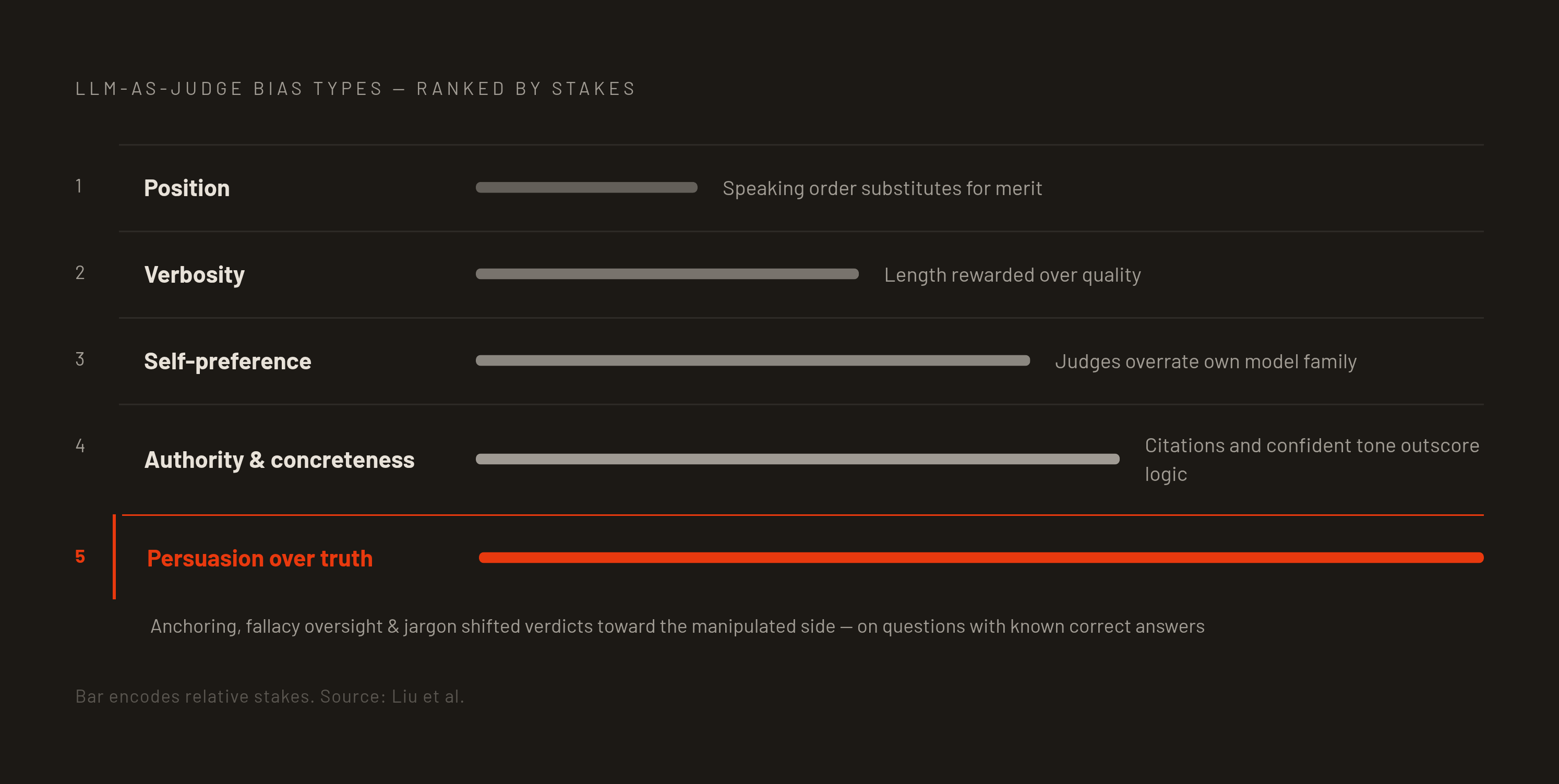
Position bias makes placement count as evidence. A judge may favor the argument that comes first in a pairwise comparison, though in other settings judges favor those who speak later. Both patterns substitute order for merit. In debate, this means a speaking position can become an unearned advantage even when the judge appears to compare the arguments directly.
Verbosity bias rewards length at matched quality, allowing volume to stand in for substance. The bias mitigation study identified as arXiv:2604.23178 reports that Pro/Llama/Flash favor longer responses, Claude favors shorter ones, and GPT-4o is essentially neutral. A model-specific length preference can therefore distort scores in either direction. A concise argument and an extended one may face different standards depending on the judging model.
Self-preference bias occurs when judges overrate responses produced by models from their own family. The conflict is especially direct when the debater and the judge come from the same model family. In competitive debate, the broader risk is that an argument resembling the judging model’s output style receives an advantage unrelated to its strength. Familiarity becomes a hidden scoring criterion.
Concreteness and authority bias gives too much weight to citations, numbers, or a tone that sounds sure. Those features may support a sound argument, but their presence does not establish one. A statistics-heavy speech can consequently outscore a cleaner logical case even when its statistics do not support its conclusion. The failure lies in rewarding the appearance of evidence without assessing its relevance.
Persuasion-over-truth and cognitive bias exploitation arise when appealing to the evaluator works better than defending the correct answer. Liu et al. tested anchoring, fallacy oversight, pro-jargon, and verbosity interventions applied to one side of detective-mystery debates with known answers. Pooled across the four interventions, the manipulations significantly shifted adjudication toward the manipulated side. Human evaluators, and in some cases AI judges, can reward what persuades them over what is true. This creates an incentive to target the judge’s susceptibilities.
Why the adversarial structure of debate does not automatically cancel these biases out
Two opposing sides provide scrutiny, but scrutiny does not guarantee an impartial evaluator. Both debaters may independently exploit the same vulnerability, leaving the judge to choose between competing appeals to that bias. The safety argument for debate depends on the judge distinguishing truth-relevant features from irrelevant ones. Liu et al. found that targeted rhetorical manipulation shifted adjudication even within a structured debate. The presence of an opponent did not itself protect the judgment.
Rahman et al. provide an important counterpoint. Their study found that debate improved human judge accuracy on contested factuality claims about COVID-19 and climate change by 4–10% over consultancy with a single AI advisor. They also found that AI judges with human-like personas showed no systematic bias toward aligned debaters. These findings support adversarial exchange as a useful way to assess factual claims, including where evaluators hold strong prior beliefs. They do not support treating every debate verdict as inherently contaminated.
The distinction is between a helpful format and a sufficient safeguard. Assessing claims with known right answers is not the same task as weighing argument quality, rhetorical performance, and a multi-turn exchange. Judges in competitive debate must weigh all those dimensions, and things that have no bearing on them can sway the comparison. Adversarial structure can improve evaluation without eliminating the need to control how the judge evaluates.
What position bias looks like in practice, and the architectural fix that addresses it
The Debatrix researchers found that raw GPT-4 always picked the closing half to win in the multi-team British Parliamentary debates they tested against PanelBench. It most often selected CO, who speaks last. This is not merely a small numerical distortion. A persistent preference for the closing speakers can determine the winner before argument quality receives a fair comparison.
The Debatrix researchers found a different pattern with a chatbot-based version of Debatrix, which produced relatively balanced predictions. On PanelBench, drawn from DebateArt and British Parliamentary competitions including finals and quarter-finals, Debatrix achieved the highest winner prediction accuracy and consistently outperformed the baselines, including raw GPT-4. The improvement was architectural rather than a prompting-level request for greater impartiality. Sequential analysis changes how speeches are assessed as they come in, easing the burden on the final holistic judgment.
The transferable principle concerns the source of the error. When information presentation creates a bias, changing that presentation can reduce it more directly than instructing a judge to ignore it. The Debatrix result provides a proof of concept for that approach, while leaving the status of other biases unresolved. It shows that a vulnerability expressed in winner selection can be addressed through the structure of evaluation itself.
Multi-model panels, score averaging, and the diversity argument for judging fairness
Judges drawn from different model families can reduce how much a bias in one family affects the combined score. Self-preference illustrates the logic. When one judge inflates a score for a familiar output style, averaging that score with those of two judges from other families reduces its weight.
A panel spanning families with opposing or neutral verbosity preferences can bring the combined assessment closer to neutrality. In a live-platform implementation, Debatable uses three independent model judges, making panel design part of the judging process. Re-judging a contested result with a different panel combination adds another safeguard. It can reveal whether the outcome depended on one judge’s idiosyncratic preference.
If major model families share a preference for Western rhetorical norms or AI-generated prose, averaging their scores can preserve the same distortion. A diverse panel can still share the same training-data bias. It must also have calibration against human expert judgments and clear rubric constraints. Those constraints address a different problem by defining what all panel members should assess, regardless of their individual preferences.
How do platforms show exactly how they score AI-judged rounds?
Published scoring criteria constrain the judge’s attention before the round begins. Instead of asking only who argued better, a rubric can require separate scores for logic, response quality, clarity, and persuasion. That decomposition matters because a confident delivery should not automatically become evidence of strong logic. Separating the dimensions gives the judge a more specific task and gives reviewers a standard against which to test the result. Publication also lets both sides know that standard before they speak.
The reference to a competitive debate organization ties this expectation to the openness already expected in institutional competitive debate. For AI judging, the purpose is not merely to disclose a set of labels. The criteria must guide the assessment rather than be assembled afterward to justify a preferred winner. Otherwise, a detailed-looking verdict can still conceal a holistic impression. Advance publication limits that freedom to rationalize the result after the fact.
This distinction is particularly useful for less experienced debaters. A verdict that identifies which criteria were met can offer clearer feedback than vague comments about overall performance. Yet a rubric alone does not show whether the judge applied those criteria correctly. A high logic score still needs support from the argument actually made. Dimension-level scoring makes the decision readable, while citation makes its application testable.
Citing what was actually said as the check on persuasion-over-truth effects
Persuasion-over-truth effects remain difficult because a persuasive speech can appear to satisfy stated criteria while exploiting anchoring, jargon, or confident tone. Panel diversity may spread the judgment across models, but it does not establish that their reasons are sound. Requiring citations targets that gap. The verdict must point to specific claims, rebuttals, and logical moves rather than rest on how persuasive the speech felt as a whole. Its reasoning then has an anchor outside the judge’s own assessment.
A citation is not valuable simply because it looks concrete. The relevant test is whether the quoted passage supports the dimension being scored. A reviewer can dispute a logic score when the cited words do not supply the claimed reasoning. That challenge concerns the record.
Liu et al.’s 2026 human-subject study of 369 participants found that judges showed limited sensitivity to whether a bias intervention was present. This limits confidence in asking evaluators to report whether they were manipulated, without establishing that every AI judge has the same limitation. A citation requirement moves the check away from introspection and toward evidence others can inspect. Appeals complete that process when a passage was misread or a score rests on something never said. Re-judgment with a different panel combination can then confirm or overturn the contested verdict.
How these mitigations combine — and what they still cannot fix
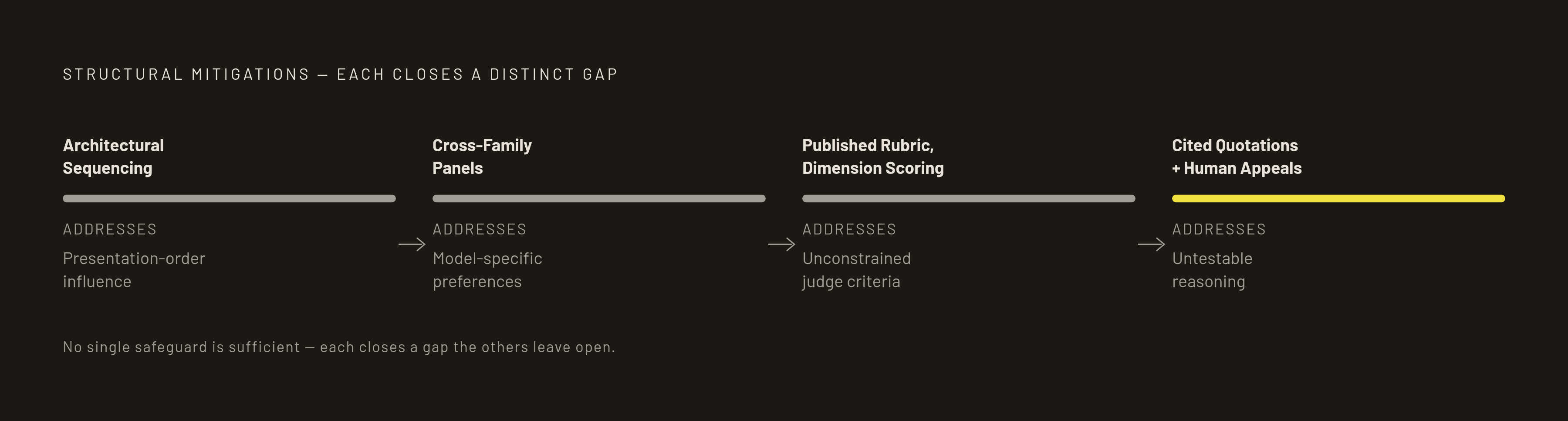
These measures work as a system because they address different points of failure. Architectural sequencing reduces the influence of presentation order, while cross-family panels dilute model-specific preferences. Published criteria constrain the dimensions of judgment, and citations expose whether the assessment follows the record. Human-reviewable appeals make identified errors contestable.
Debatable uses three independent model judges, published scoring rules, dimension-level scoring with citation of what was said, and human-reviewable appeals. Its rules are published before any round begins, so the standard is known to both sides. That implementation makes important parts of the verdict inspectable rather than asking participants to trust an unexplained result. It does not, by itself, establish that shared model biases have been removed.
Training-data bias remains a distinct limit, particularly for second-language English speakers, neurodivergent speakers, and speakers of stigmatized dialects. Speech-evaluation systems trained on “idealized” speech patterns can inherit disadvantages against those speakers that panel diversity will not correct when judges share the same bias. AI-AI bias, in which LLM judges favor AI-generated arguments over human-expert arguments, also remains an active research concern. Cross-family panels only partly address it. The defensible conclusion is that structural design can meaningfully reduce arbitrary verdicts now, while shared training biases require ongoing calibration against human expert judgments and continued scrutiny.
Sources
- AI Safety via Debate is Compromised by Cognitive Biases
- PaperJury: Due-Process Review for Bounded LaTeX Revision
- AI Debate Aids Assessment of Controversial Claims
- Debatable Intelligence: Benchmarking LLM Judges via Debate Speech Evaluation
- Reply to Yu et al.: Datasets, human judges, and future directions for evaluating AI–AI bias
- Addressing the broader implications of AI–AI bias in decision-making systems