What AI Judges Miss — Limitations of Automated Debate Scoring
Bias, compression, and blind spots limit what an AI verdict can tell you.
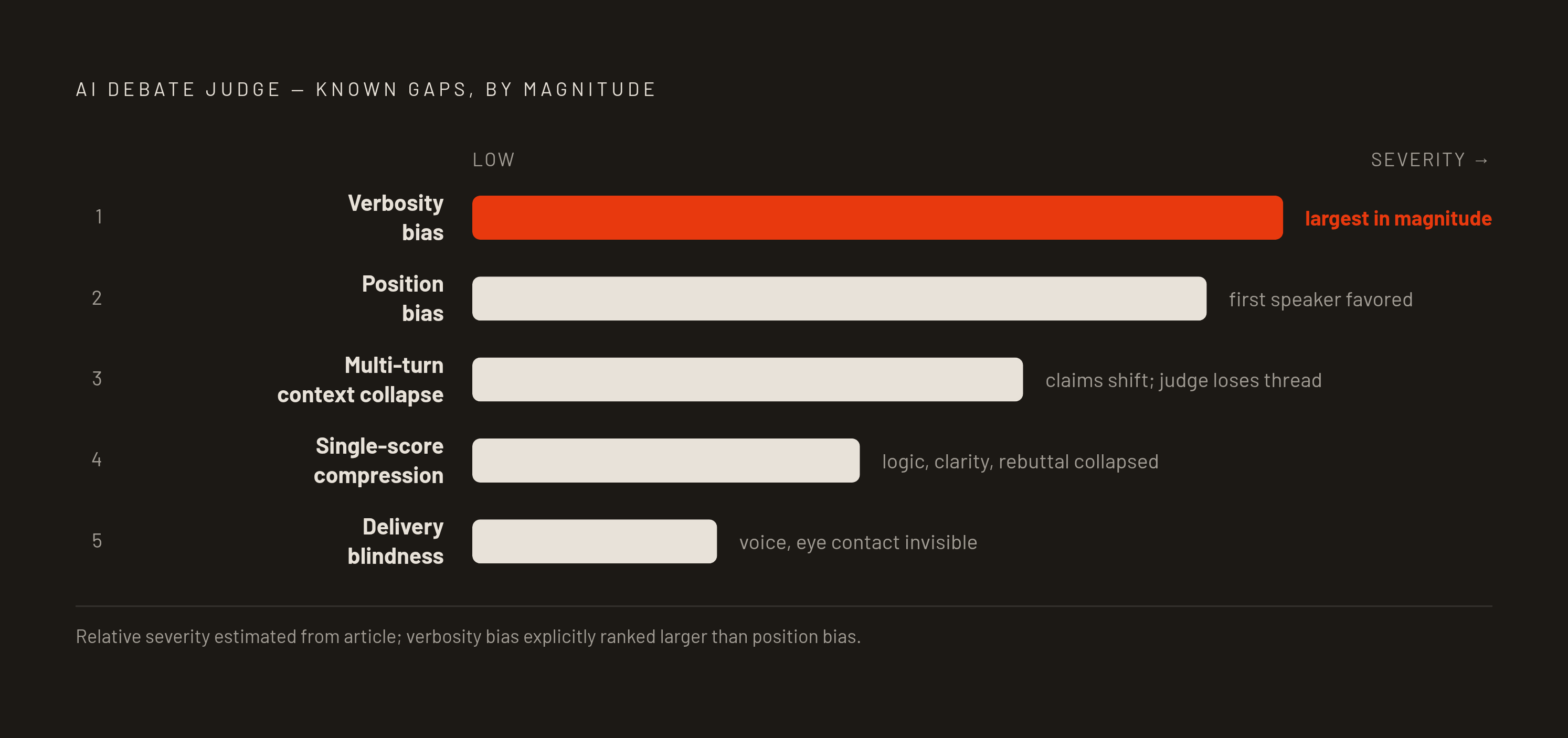
AI debate judging is useful, but its verdicts are not complete accounts of performance. Position bias, verbosity preference, collapsed multi-turn context, and single-score compression can separate a score from the quality of an argument. Understanding those gaps makes automated feedback more useful because it clarifies what a verdict can support and where human judgment remains necessary.
Why AI judging is worth taking seriously before criticizing it
Alzarahni et al.’s 2026 study in Language Testing in Asia found that GPT-4o had an exceptionally high level of statistical reliability in pairwise comparative judgment. It also accounted for the highest share of variance in expert rubric scores among the rater groups tested, outperforming crowdsourced workers and peers. That is substantive evidence of useful evaluation capacity. It makes outright dismissal difficult to defend.
Evaluation architectures also extend beyond a single model assigning a score. Multi-agent frameworks distribute roles such as domain expert, critic, and defender, more closely approximating a panel of human judges. In a separate test, the Paris Olympics Taekwondo feasibility study found that an AI system and international referees largely agreed, while the system sharply cut the average time needed for review. These different tasks provide distinct evidence of evaluation capacity. Together, however, they establish a credible case for automated evaluation whose gains in consistency and scale come bundled with structural limitations.
How the single-score format compresses what a debate actually contains
A debater receiving one verdict number cannot tell whether it reflects strong logic, effective rebuttal, clear expression, or persuasive presentation. Those qualities need not move together. A speech can be logically sound but unresponsive to the opponent, while a clear and persuasive answer can rest on weak evidence. Combining these dimensions into one number conceals the trade-offs that produced it.
This is a compression problem before it is a bias problem. Once distinct assessments become an aggregate, the lost detail cannot be recovered from that number alone. A high score can thus go to very different performances, and what it says about each one can differ. The same is true of a low score.
Structured outputs that give separate scores for helpfulness, factuality, and clarity help with this, but most debate-scoring systems in use give a single verdict number. The format itself restricts what the debater can learn. When position, length, or style affects the result, the aggregate does not identify the affected dimension. Better tuning may improve the judgment, but it cannot make a lone number disclose information that the format leaves out.
Position bias: why the opening speaker has a structural scoring advantage
In pairwise AI judging, the argument processed first gains a systematic advantage unrelated to merit. The relevant order is the judge’s processing order. When that follows speaking order, the opening speaker benefits from a structural asymmetry. A close result can consequently reflect both argument quality and placement.
Autoregressive models process a sequence in which their representation of the second argument is conditioned on the first. The two arguments therefore do not enter the comparison on identical terms. An instruction to judge fairly cannot fully remove that asymmetry. Position bias is not simply an omitted sentence in the rubric.
Running both orderings and averaging the results is an established mitigation in production LLM judging, although most single-pass debate-scoring implementations do not apply it. For debaters, the practical implication is measured skepticism toward a narrow loss when their argument was processed second. Logic and responsiveness subscores deserve more weight than the aggregate in that situation. This limits how confidently the score gap can be read as a quality gap.
Verbosity bias: how longer answers earn higher scores regardless of quality
Verbosity bias rewards length regardless of how good the argument is, and its effects differ across model families. Unlike position bias, it does not depend on which speaker comes first. Length-penalty clauses and token-count normalization offer partial mitigations, but no strategy reliably eliminates the preference across all models.
The consequence extends beyond a distorted verdict. When debaters learn that longer speeches earn higher scores, they can start practicing to please the scoring system. That is the Goodhart’s Law problem here. A measure intended to reward better argument begins to reward behavior that weakens precision, and the habits developed in practice diverge from those useful before human judges.
Published scoring criteria make this preference easier to check by showing, before the round begins, whether scores are normalized for length. The lesson for improvement is to treat suspiciously high scores on long speeches as possible artifacts of verbosity preference. Feedback on whether the argument would hold at half the length provides a useful counterweight.
Collapsed multi-turn context: what AI judges lose as a debate develops
Debate requires a judge to track how claims change under pressure. An opening claim may be narrowed after a rebuttal, conceded in part, or rebuilt around stronger evidence. Those changes define the exchange. A judge that misses their relationship can reward consistency of wording over progress in reasoning.
AI judges still struggle to track arguments and weigh them as a long discussion develops. Single-turn biases can at least be partly mitigated through changes to evaluation procedure. Multi-turn context collapse is harder because it concerns how much of the exchange the model can usefully track and weigh.
Consider a concession-and-rebuild move in round three. A debater may acknowledge a valid objection and reconstruct the case, yet score below an opponent who repeatedly asserts a weaker claim because the earlier, reinforced framing receives more weight. A written decision that cites specific turns makes that failure easier to see. Its value lies not merely in detail, but in showing whether the judge recognized the concession, the response, and the revised argument as connected moves.
Style and tone bias: what AI judges reward that human judges do not
AI judges reward recognizable structural polish, including numbered arguments, formal paragraphs, and polished openings. Style bias has been documented as larger in magnitude than position bias. A well-formatted argument may therefore receive credit that its substance does not justify.
The reverse can affect forceful or emotionally expressive speakers. AI judges can penalize these styles even when human judges and live audiences respond favorably to them. Humor, cultural references, and creative analogies also fall outside the patterns that models assess reliably. A chessboard metaphor or a well-timed aside may register as noise even when it is the most persuasive moment of the round.
The Language Testing in Asia study found algorithmic over-consistency in GPT-4o’s infit statistics compared with human judges. Reliable pattern matching does not supply introspective understanding of why a phrase succeeds with listeners. For a debater whose natural style scores poorly, the productive question is therefore whether the decision identifies a reasoning defect or merely disfavors its expression. That distinction permits disagreement with the verdict without dismissing the evaluation process.
What AI judges cannot see at all: delivery, non-verbal cues, and live-room dynamics
A text-based judge has no access to voice, pacing, eye contact, facial expression, or audience response. A transcript preserves words. The signals available in the input set a boundary of the medium that applies across models and rubric instructions.
The Taekwondo study shows a related limit even when the system has more to work with. Its discrepancies were concentrated in visually ambiguous cases involving minimal contact or occlusion, despite access to high-definition video. A score labeled “delivery” or “persuasion” must rely on proxies such as word choice, sentence rhythm, and structural markers.
The appropriate use of such a score is as a prompt for self-assessment. Does the transcript read as confident and clear? If it does and the score is low, the mismatch warrants examination. If the transcript reads as scattered, the score may point toward a real weakness without establishing how the speech sounded in the room. Logical structure and coherence remain assessable, but they cannot stand in for every dimension of delivery.
The calibration ceiling: when AI judges are right for the wrong reasons
Agreement with human scores does not by itself establish high-quality judging. An AI judge calibrated to median human responses can reproduce average biases as faithfully as average insight. A system may match typical evaluations while failing on edge cases that a more expert judge would recognize.
The Language Testing in Asia study recommended AI-generated comparative judgments as supplementary tools to expert human judgment. That qualification is compatible with its strong reliability findings. Consistent scoring and expert discrimination are different properties. Over-consistency can make results look unusually stable without showing that the model understands the distinctions behind them.
The NeurIPS 2026 study Humans Correct Their Judgments Through Debate, but Weaker AI Models Do Not found no accuracy gains for weaker AI judges, with accuracy declining in some settings. Such judges may fail to distinguish a sound argument from a persuasively framed bad one. This leaves room for judge hacking: a confident tone, formal structure, and the right length can sway the judge without better reasoning. The practical implication is to use the verdict as one input into evaluation.
How to read an AI verdict accurately given these gaps
The most useful reading begins with the relationship between the subscores and the written reasons. When logic and responsiveness score highly but the total is low, style or tone may explain the gap better than substantive failure. Judgments backed by the text should carry more weight than claims about confidence or delivery. A narrow loss for the second speaker also calls for care, especially when the system reports only one processing order.
The explanation provides the next test. A decision that quotes or paraphrases specific arguments and explains their success or failure exposes more of its judgment than a generic summary does. Turn-specific references show whether the judge followed the exchange. They make it possible to distinguish a rejected argument from one the judge apparently failed to track.
Published scoring rules set out the criteria ahead of time, while citation-based decisions tie the result to what was said in the debate. Three-model panels reduce position and style bias more effectively than a single model because independent models are unlikely to share exactly the same direction of bias. Human appeals then provide review where automated reasoning is disputed. These features make a verdict a defensible starting point rather than an opaque decree, without promising that every decision will be correct.
Why these limitations argue for more debate practice, not less
Interpreting imperfect feedback is itself a form of argument analysis. A debater who distinguishes supported criticism from a formatting preference is evaluating evidence, locating gaps, and testing whether a conclusion follows. That skill transfers directly to live rounds.
The debate study found human judge accuracy rising to 57.6% through debate, outperforming consultancy in improving judgments from prior beliefs. Structured adversarial exchange can improve reasoning despite imperfect evaluation. The appropriate response is to combine AI-judged practice with live opponents and real-time feedback, since neither source alone provides the same calibration.
Access to an automated verdict on every completed round also removes dependence on a qualified human judge being available each time. That greater volume of feedback can accelerate improvement when interpreted accurately. Systems with published rubrics, citation-based verdicts, multi-model panels, and human appeals give people ways to review that practice. Their value is that they create more opportunities to exercise judgment.
Sources
- Humans Correct Their Judgments Through Debate, but Weaker AI Models Do Not
- When AIs Judge AIs: The Rise of Agent-as-a-Judge Evaluation for LLMs
- Faster, more accurate? A feasibility study on replacing human judges with artificial intelligence in video review for the Paris Olympics Taekwondo competition