Consistency Guarantees in AI Debate Judging — What the Appeals Chain Tells You About a Platform's Confidence in Its Own Scores
How platforms handle appeals reveals whether they trust their own AI scores.
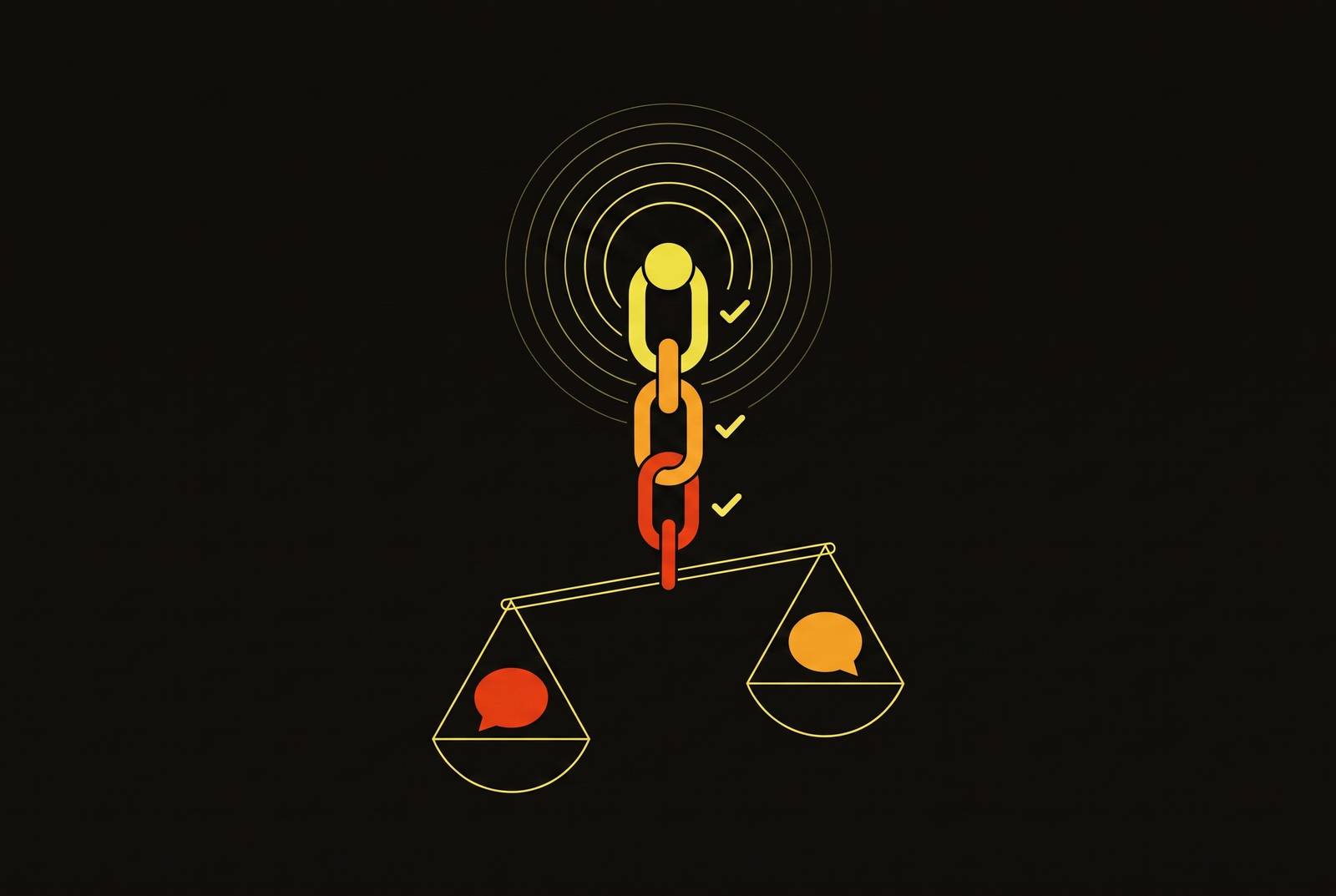
Debate Ladder offers live spoken debate practice against an AI opponent, with automated judging across logic, responsiveness, clarity, delivery, and persuasiveness. Those named dimensions do not, by themselves, establish a published pre-round rubric or an independent appeals process. For anyone choosing an AI debate platform, the strongest signal of confidence is whether its scores can be examined, challenged, and corrected.
Why consistency alone is not enough to trust an AI judge
The intuitive assumption is that if an AI gives the same score every time, it must be right. Yet a judge can reproduce the same biased verdict with high confidence. A system that reliably rewards the wrong feature of an argument does not become more trustworthy by doing so again.
Reliability without Validity, a 2026 study by Norman, Rivera and Hughes, examined more than half a million AI judgments and exposed the limits of agreement with human labels. Raw agreement counts chance matches as successful judgments, while Cohen’s kappa adjusts for them. The study found a large gap between those measures on every judge and benchmark tested, calling the effect “kappa deflation.” A headline accuracy figure can therefore overstate the skill behind the verdict.
That distinction changes what a platform’s reproducibility claim establishes. It answers whether the judge repeats itself, but not whether it rewards the better argument. Agreement across a benchmark also does not show that judging is fair in disputed debate rounds. Trust requires a way to inspect the basis of a decision, especially when a repeatable result is precisely what the debater disputes.
The three documented ways an AI judge gets it wrong regardless of consistency
Bo Yang and colleagues’ FairJudge, published in February 2026, identifies three compounding limitations, which are wrong rubric, non-semantic bias, and score-comparison inconsistency. The first concerns what the judge measures. Criteria that predict human preference in casual conversation do not transfer cleanly to structured argumentation. A debate judge can therefore apply its criteria faithfully while rewarding chat-quality heuristics.
Position, length, formatting, and model provenance can influence a verdict without improving an argument. Position bias can cause a judge to change its choice when candidate positions are swapped, while verbosity bias rewards longer answers regardless of quality. Self-preference and family bias can lead a judge to favor outputs from its own model family. The harmful form of self-preference is specifically a failure to penalize its own errors.
Score-comparison inconsistency can produce circular preferences in which A beats B, B beats C, and C beats A. A pairwise verdict can also contradict the judge’s own pointwise scores. These failures do not stay neatly separated. Correcting presentation bias leaves a wrong rubric intact, while publishing numerical scores does not establish that the judge will compare those scores coherently.
Carro et al., NeurIPS 2026, names the sharpest downstream consequence as “judge hacking.” Advanced AI systems and skilled human debaters can learn to take advantage of what a judge tends to favor. The target then shifts from truth to reward. In scored practice, that creates a direct conflict between learning to argue well and learning to produce whatever the model favors.
Why panel design fixes some of these problems but not all of them
The RAND Corporation’s Judge Reliability Harness evaluated four judges across safety, persuasion, misuse, and agentic benchmarks and found none uniformly reliable. Independent judges from different labs make it less likely that one wrong call will decide the result.
An independent panel can have each judge produce a score and written rationale without seeing the others’ reasoning. A majority then determines the result, with two of three judges sufficient to select a winner. This separates initial judgments from persuasion within the panel. It does not establish that the judges use the right rubric or lack shared biases.
Carro et al. found that, for weaker language models used as judges, none of the multi-judge protocols tested significantly improved group accuracy, including weighted voting, even as the number of judges increased. The study also identified a minority-judge effect in non-diverse deliberation, where incorrect positions can be more persuasive than correct ones. More voices did not necessarily improve the decision. But weighted voting did make human supervisors significantly more accurate.
The distinction limits what panel agreement can prove. Independent scoring can reduce reliance on an individual judge, but a majority vote cannot certify its own correctness. An appeals chain addresses the uncertainty that remains after the panel has reached its decision.
What an appeals chain actually has to do to be structurally meaningful
For appeals to work, the criteria must be published before the round. Without them, a debater cannot establish that a verdict applied the wrong standard. A retrospective explanation is not an equivalent safeguard. The published rubric gives both the participant and the reviewer a common basis for deciding whether the score follows the rules.
The second requirement is evidence in the verdict. A score must point back to the moment in the conversation that caused it, so that a challenge has something concrete to examine. General praise or criticism cannot perform that function. Without a connection between evidence and score, review becomes a disagreement between someone who says the result feels wrong and someone who says it looks right.
EU legal provisions 50 and 86, effective August 2, 2026, also require transparency in the EU cases they cover. Article 50 requires disclosure when AI systems interact directly with individuals, when emotion-recognition or biometric-categorisation systems are used on individuals, and when AI-generated content, including deepfakes, is published. Article 86 creates a right to explanation when a decision produces legal or similarly significant effects that the person considers adverse to their health, safety or fundamental rights.
The third requirement is an independent human reviewer. If software issued the disputed score, a human must be available to review it rather than leaving the challenge with the original decision-maker. Reconsideration alone does not establish independent review. Carro et al.’s findings also caution against assuming that routing a challenge to the same class of weaker model will correct the original error.
The fourth requirement is transparency about the appeals funnel. Participants must discover the process, understand it, make the effort to use it, and reach a reviewer with capacity to respond. A near-zero rate may show how hard it is to get a review rather than how well the judges work, while a high rate can show both frequent errors and a working way to fix them.
How current platforms design their judging and appeals architecture
ArguFight fixes criteria before the round, giving users a prior standard against which to examine a call. Its appeal process includes AI re-evaluation using different judge combinations and a human appeals endpoint. Those are distinct layers of review. Different combinations can reconsider the result, but the human endpoint is what supplies the independent human review described above. Its presence acknowledges that an AI panel can be wrong.
VersyTalks makes a different architectural choice by removing AI from the outcome decision. Its text-based debate community collects upvotes on arguments, which feed a monthly leaderboard. Community voting supplies a different kind of legitimacy. It sidesteps AI-judge reliability concerns rather than solving them, trading automated scoring’s speed and scalability for participant judgment.
For students who want live spoken practice, Debate Ladder lets users argue PRO or CON through an opening, rebuttal, and closing against an AI opponent. Its AI judge scores logic, responsiveness, clarity, delivery, and persuasiveness. Ranked wins move an Elo rating that starts at 500. That makes score validity consequential beyond one round, because errors can accumulate across a user’s competitive record. Named scoring dimensions explain the categories being assessed, but they do not alone establish how the platform resolves disputes.
DebateOwl focuses on preparation rather than live judging, building cases and practice rounds against the other side. It is available after a short free trial through a low-cost monthly subscription. Its role is different from scored competition. Because it is not a judging platform, its value does not depend on providing an appeals architecture for competitive verdicts.
These differences prevent a single feature label from doing the work of a comparison. Spoken practice, community voting, preparation, and appealable AI scoring answer different needs. For students without well-funded programs, access to trustworthy scored practice is especially important. Accessibility and reviewability are separate qualities, however, and a low barrier to entry does not establish that a score can be challenged.
The one feature no current platform publishes — and why its absence matters
What is missing from public view is a criterion-change history that shows how judging changes after successful appeals. None of the platforms described here publicly closes that loop. A human can reverse a result and still leave in place the rule that led to it. The stronger architecture connects a dispute to calibration, a rewritten criterion, and a published decision changelog.
Successful appeals are especially useful evidence because they show cases where a human reviewer rejected the AI verdict. Those cases can expose a faulty rubric or a bias that dominated the score. Correction need not stop at the individual round. Without a published history, however, users cannot distinguish a platform that learns from reversals from one that resolves each complaint in isolation.
Related research on reasoning-trace consistency points toward better tools for review. The research finds that correct reasoning traces reproduce their answers more often than incorrect traces when the remainder is regenerated from a partial trace. This tests more than whether the same verdict comes back. In principle, the signal could help flag decisions for review before a participant files an appeal, but it does not establish a ready-made debate-judging method.
The practical next step for platforms is to publish overturn rates together with criterion-change histories based on successful appeals. Neither shows how good the judging is without further explanation. The user-facing question is therefore not simply whether a platform has an appeals path, but whether it shows what it learned from appeals.
What the appeals structure tells you before you debate a single round
For practitioners choosing a platform, the framework reduces to four questions. Are the scoring criteria published before the round starts, or only visible after the verdict? Does the verdict cite specific moments from what was said, or only deliver a score and a general comment? Is a human reviewer available for disputes, or does the platform route challenges back to the system that issued the original score? Does the platform publish what it has learned from successful appeals, or does the dispute process disappear behind a closed door?
The distinction is practical for students without institutional resources. Feedback is a stronger guide to improvement when the recipient can examine why it was given and challenge a demonstrable error.
Carro et al. found that debate improved human judges’ accuracy relative to their prior beliefs, whereas a consultancy baseline with a single expert arguing for one answer did not. Debate improved accuracy for human judges alone, giving independent human review a role beyond additional automated reassurance. An appeals chain becomes a mechanism for better judging when a successful challenge can change not only who won, but the criteria applied to the next round.