How AI Judges Score Interruptions and Overlapping Speech
Scoring interruptions fairly starts with knowing who spoke.
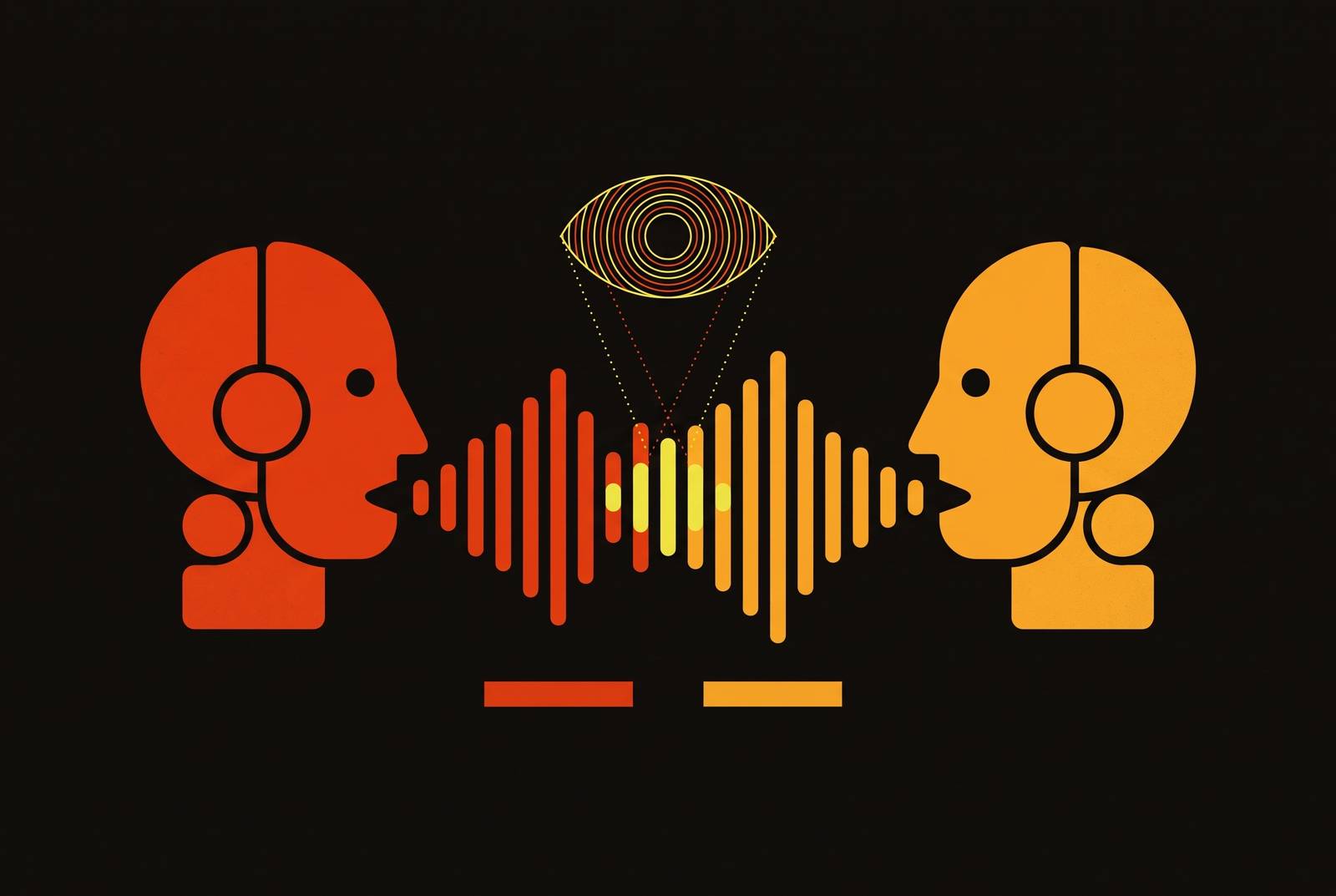
AI judges score interruptions and overlapping speech reliably only when they can first identify who said what. For a live voice debate platform with AI judging and a published scoring rubric, clear criteria are necessary but insufficient, because attribution errors can distort every downstream score.
Why diarization comes before judgment: the layered structure of an AI debate scoring pipeline
Speaker diarization divides an audio stream into segments assigned to particular voices. Automatic speech recognition, or ASR, then transcribes the attributed segments, producing words with confidence scores. Argument analysis then checks the logic, response quality, clarity and persuasion in the text assigned to each speaker. The order is decisive for the resulting judgment. A judge cannot evaluate someone’s contribution until it knows which contribution was theirs.
This architecture also determines how the system measures participation. Talk-time ratios, interruption counts and the record of which debater made each claim all depend on the diarized output. They are not independent checks on that output. If a segment receives the wrong speaker identity, a later metric can accurately process the segment while reaching the wrong conclusion about the debater.
Debatrix illustrates how argument evaluation can proceed once speeches have been separated and attributed. Its LLM judge analyzes each speech chronologically, with awareness of earlier speeches already assessed, rather than evaluating the entire debate in one undifferentiated pass. That sequence supports analysis of how arguments develop and receive answers. In a voice pipeline, however, the usefulness of that context still depends on assigning the contributions correctly.
Why overlapping speech is structurally the hardest input for the diarization layer
Overlapping speech challenges the assignment rule itself. In the clustering approach described here, diarization assigns each audio segment to a single voice, while simultaneous speakers place more than one voice inside the same interval. This is not simply a louder or noisier version of ordinary speech. The input conflicts with the system’s basic unit of attribution. Interruptions occur precisely at that fault line.
Published benchmarks commonly exclude overlapping segments when calculating diarization error rates. Their figures therefore leave out some of what happens in live debate, where speakers challenge, answer and sometimes talk across one another. Research presented at INTERSPEECH 2026 established a further tension, finding that increasing speech overlap benefited ASR accuracy but degraded diarization accuracy. Improving one objective did not resolve the other.
The Debate Analyser system, documented in March 2026, notes that background noise, differences in microphone quality and speech that varies in clarity make real-world audio harder to process. Even without them, simultaneous speech remains structurally difficult to attribute. A debater who interrupts or is interrupted therefore produces the kind of input most likely to weaken the foundation of the eventual score.
How diarization failures cascade into scoring errors the debater never sees
A misattributed rebuttal can make a debater appear to have dropped an argument they actually answered. The opponent may receive credit for the response, while the speaker who delivered it loses credit for responsiveness. The error becomes a judgment about argumentative performance. Nothing in the wording of that judgment necessarily reveals that its origin was an audio-processing failure rather than a disagreement about the argument’s strength.
Other measures inherit the same mistaken assignment. Talk-time ratios can suggest dominance or passivity that the debater did not display, while interruption counts can be inflated or reduced to zero for one side. Sentiment and confidence signals attached to the wrong voice can also distort delivery scores. These are different consequences of one upstream error.
Debatrix’s chronological analysis offers some protection because a misattributed contribution may contradict established context. That contradiction can expose a problem, but context cannot reliably repair ambiguity that the diarization layer never flags. A written explanation can make sense even when it assigns words to the wrong speaker. Even when a decision cites words actually spoken, its evidential value depends on whether those words belong to the debater being assessed.
What Points of Information reveal about the limits of format-aware AI judging
Points of Information make this vulnerability a test of format accuracy. British Parliamentary and World Schools debates have rules that allow some interruptions, so every intervention does not count as disorderly conduct. The WUDC standard protects the first and last minute of each speech from POIs, while allowing speakers to accept or decline offers outside that protected time. Accepted interventions can generate simultaneous speech. A format-aware judge must tell when an exchange follows those rules and when it disrupts the debate.
Scoring POIs therefore requires more than counting interruptions. The judge must attribute the intervention and the response correctly before assessing whether a speaker accepted enough challenges, used an intervention strategically or sought to disrupt. When the host speech continues through a POI, that task becomes especially difficult. One attribution failure can misscore both participants. A rule about POI usage cannot compensate for an inaccurate record of who offered or answered one.
In the UNC Carolina Law experiment in October 2026, without interruptions from the AI justices, one student covered nearly every point she had planned, something she said almost never happened before a real bench. Removing challenge changed the argumentation itself. The coaching professor’s teaching, including continuing until interrupted and reading changes in tone and posture, describes skills that an attributed-text judge cannot model or reward. Nor can such a judge fairly penalize a debater for failing to demonstrate them.
What argument-quality scoring can and cannot do once attribution is settled
LLM-based evaluation can assess logical coherence across speeches, whether a response addresses the opponent’s actual claim and whether evidence supports the proposition attached to it. These are substantive features of debate performance. Their evaluation is most useful when the decision makes the connection between a specific contribution and the criterion applied to it.
The EMNLP 2025 benchmark, Benchmarking LLM Judges via Debate Speech Evaluation, examined over 600 annotated speeches. It found that larger models aligned with individual human annotators on relative rankings while assigning systematically lower scores overall.
The same benchmark found that judges rated GPT-4.1 speeches above those of human expert debaters. That raises a concern about rewarding machine-generated polish independently of argumentative merit, though it does not establish that every polished speech receives undeserved credit. Smaller models consistently underperformed on the task. Infrastructure choice consequently affects the quality of analysis even after the audio has been handled correctly.
The 2025 study AI Debate Aids Assessment of Controversial Claims found that human judges were more accurate on controversial factual claims with debate than with consultancy. That supports the value of adversarial exchange in exposing errors, without proving that automated verdicts are correct. Text also leaves important delivery signals out. The Debate Analyser adds audio prosodic analysis and facial emotion recognition to NLP to address vocal emphasis, speech rate, pauses and facial engagement, although each added modality brings sensitivity to real-world variability.
What the research on interrupting AI agents suggests about judging interruptions in debate
The University of Electro-Communications / AIST study treated interruption as a possible contribution to reasoning. Its agents processed speech sentence by sentence and used an “urgency score” that could trigger a mid-speech intervention. Agents that interrupted on detecting errors or critical insights outperformed rule-bound agents on complex reasoning tasks. Flexibility improved both decision-making accuracy and efficiency.
That finding suggests a different way to understand competitive interventions. An interruption may identify the exact point at which a debater detects a consequential error. Its timing can therefore contain strategic information. A judge that loses the intervention or assigns it to the wrong speaker may miss not only the words but also the significance of the challenge.
The research does not establish an interruption strategy for live debate. MMLU benchmark tasks differ from spoken rounds, and agent decision-making is not the same task as judging human speakers. The distinction limits the inference. Current pipeline-based judging is still weakest when an interruption could reveal where a debater spotted an error. The research supports treating interruptions as information worth capturing.
How can students use live spoken debates with automated judging to get reliable decisions?
Debaters should make speech attributable without abandoning genuine engagement. Where possible, a debater should finish a sentence before voices overlap, so that one voice carries a full thought. Brief pauses before and after an interruption or POI give the diarization model a natural segment boundary. The pause has a technical purpose beyond politeness. It separates contributions that the scoring layer must later evaluate independently.
Debaters should also finish a point after being interrupted. A partial argument swallowed by overlap may disappear from the transcript or receive the wrong speaker identity. After accepting a POI, the speaker should give a complete response before resuming the main speech. One-word or partial answers are especially vulnerable to misattribution. These habits keep the words the judge needs to assess responsiveness and make the exchange tidier.
The written decision then becomes a diagnostic tool. A debater can compare its cited speech with their memory of the round to identify correct attribution and possible failures. A published rubric reveals the scoring rules, while citations reveal the contributions to which those rules were applied.
Live, spoken, judged rounds against a real opponent or an AI opponent provide the setting for practicing these habits. Written debates and argument maps do not expose speech to the diarization layer, so they cannot show how it handled a pause, intervention or overlapping answer. The practice task is therefore specific. It is to deliver arguments that remain identifiable under the conditions in which the judge must process them.
Where the pipeline’s known limits should change how debaters weight an AI verdict
Debaters can put more weight on an AI decision’s view of argument quality when the words it cites are assigned to the right speakers. Overlap-heavy passages require more caution, especially where the explanation substitutes vague summaries for coherent citations. Debaters should check whether an argument marked as dropped appears under their name in the transcript and whether they actually gave a praised rebuttal. These checks test the decision’s foundation.
The UNC coaching professor’s objection also defines a genuine boundary. Reading a judge’s interruptions, tone shifts and posture is a skill that a text-based evaluator cannot model or reward. AI judging is therefore strongest as a practice and development layer. It is weakest as the sole judge of record in high-stakes rounds where human evaluation includes signals outside the pipeline.
Palaestra Research’s 2026 study adds a separate reason for restraint. It found that debate underperformed consultancy in a majority of tested coding and reasoning conditions, while dual debate flipped a substantial share of verdicts in ways that reduced accuracy. Those results differ from the findings on controversial factual claims because the tasks and conditions differ. Adversarial structure is not a guarantee of truth. An exchange can expose errors without reliably producing the correct final verdict.
The access case nevertheless remains substantial. For many debaters without well-resourced teams or programs, the alternative to automated judging is no judged round at all. Consistent evaluation, transparent scoring rules and availability can make structured practice possible. Understanding attribution lets those debaters use feedback selectively, strengthening arguments where the record is sound and questioning decisions where overlap has compromised it. That is a practical expansion of access to quality practice, without requiring confidence the system has not earned.
Sources
- AI justices got the right answer at Carolina Law. The students who argued before them say something was still missing.
- Inference-time Generative Debates on Coding and Reasoning Tasks for Scalable Oversight
- Debate Analyser: An AI-Based Multimodal Sys-tem for Automated Debate Evaluation and Winner Prediction
- Debatrix: Multi-dimensional Debate Judge with Iterative Chronological Analysis Based on LLM
- Benchmarking LLM Judges via Debate Speech Evaluation
- AI Debate Aids Assessment of Controversial Claims