How to Review a Completed Debate Decision to Accelerate Improvement
Turn each debate loss into one drillable skill, and use AI feedback with care.
A completed debate decision accelerates improvement when it is read as a diagnostic tool. The task is to identify the specific skill failure that turned the round, write it in one sentence, and drill that skill before competing again. For daily practice without a partner, AI judging can shorten the feedback loop, but its decisions are evidence to examine.
Why most debaters stall after losses even when they practice hard
A close round ends, the result comes in, and the debater who lost still cannot say what should change before the next competition. The arguments seemed competitive, and the final speech felt persuasive. Yet the decision points to something else, perhaps an unanswered argument or an impact comparison that came too late. The written decision contains useful information, but reading it only to understand who won leaves that information unused.
WSDC Academy's improvement guide frames this plateau as an information problem. A round tests how well a debater performs without always explaining why. A rebuttal may have answered a weaker version of the argument than the opponent delivered, while the debater remembers having answered it thoroughly. Without a diagnosis, further practice defaults to repeating that same response. More rounds then accumulate experience without extracting the information needed to change how the next round is debated.
What the four stages of debate skill reveal about where feedback actually lands
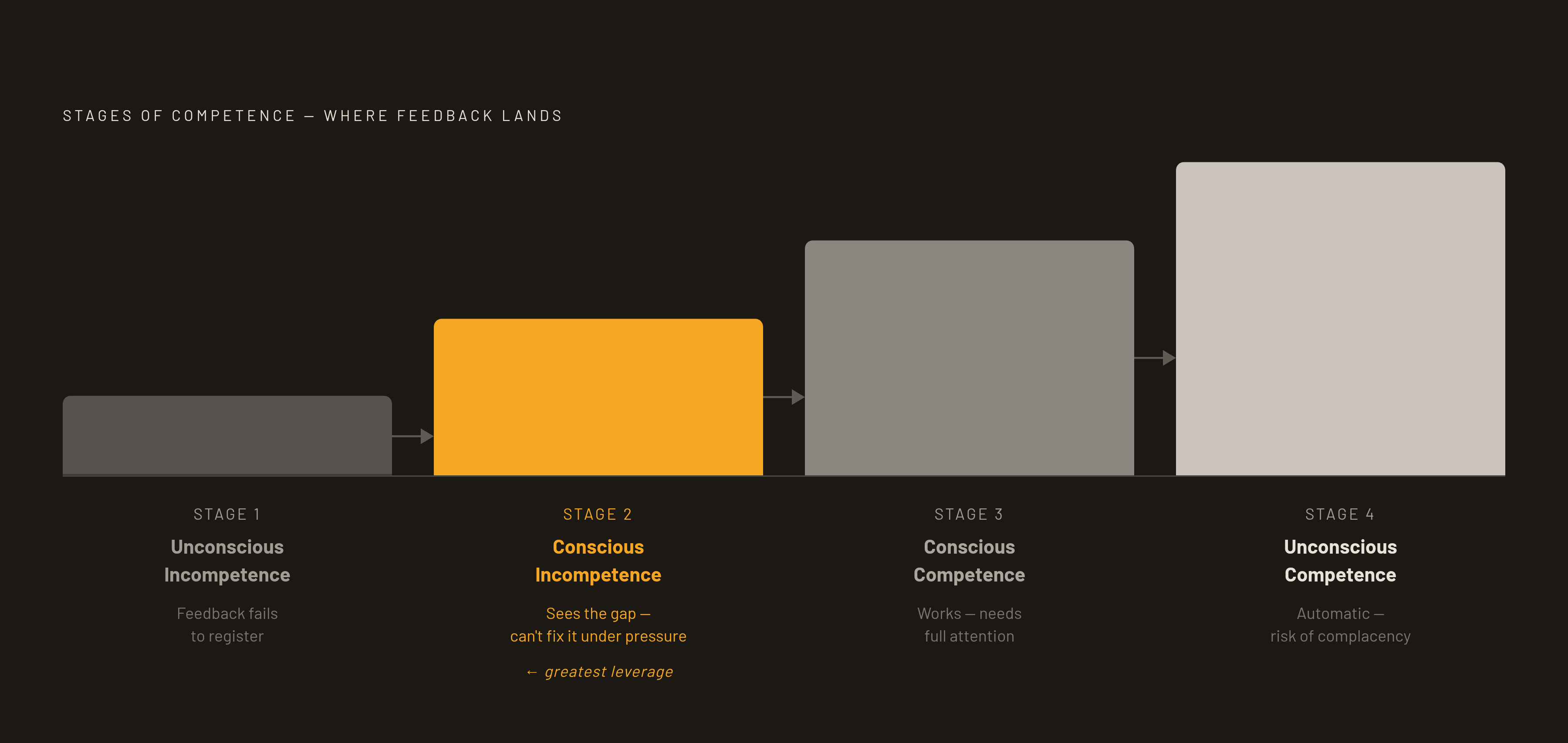
SuperDebate's debater's path describes four stages of development, namely unconscious incompetence, conscious incompetence, conscious competence, and unconscious competence. At stage one, a debater does not yet recognize what good execution looks like, so even a precise explanation may fail to register as actionable. The gap remains difficult to see. Receiving feedback and knowing how to use it are separate abilities.
At stage two, the most common competition-level stage, the debater recognizes a weakness but cannot yet correct it under pressure. This is where a well-read decision has particular leverage. SuperDebate describes a debater who knows an opponent's statistical argument is flawed but freezes, recognizing the indictment only afterward. The decision can turn that frustrating memory into a nameable pattern. Instead of leaving the round with a general sense of having missed something, the debater can identify the response that failed to appear when needed.
At stage three, the technique is available but its application still requires conscious attention. A decision can therefore pinpoint a learned technique that misfired. Stage four does not eliminate the need for review. SuperDebate identifies complacency as a danger when excellence becomes routine, and unfamiliar domains can expose where automatic execution has not yet developed. The practical distinction is whether feedback reveals an unseen gap, names a recognized one, or corrects the use of an established technique.
What a written decision is actually built from, and what each part can tell you
A useful written decision records which arguments were weighed, which were dropped, and where the judge's reasoning turned. It follows the argument itself through claim, warrant, impact, and comparative weight. A claim identifies what the debater asked the judge to accept, while its warrant supplies the reason for accepting it. The impact establishes the consequence, and comparative weighing explains why that consequence should prevail over the opponent's.
Weighing deserves particular attention because an argument can be supported and still lose the comparison. A decision may accept that an impact is large but prefer the opponent's impact because it is more probable or arrives sooner. It may show that no comparison was made across magnitude, probability, or timeframe. The distinction between burden of proof and burden of persuasion is useful here, because introducing sufficient evidence does not establish why the judge should prefer that argument over a competing one.
A recorded drop identifies a different problem. In most American high school and college formats, including Policy, Lincoln-Douglas, and Public Forum, judges treat a dropped argument as true for the rest of the round. The decision may therefore show where an unanswered argument became a concession that decided the round. By contrast, a policy judge ruling the affirmative untopical is not saying the plan is bad policy. That ruling says the affirmative failed to prove the resolution, so it points to a skill other than impact comparison.
A comment locating missing support in the third rebuttal gives the debater something to investigate, while “your argument was weak” does not identify a repair. The same standard applies when reading the decision. The useful detail is the speech, argument, or comparison that explains the judge's reasoning. Without that location, even accurate criticism can remain too broad to guide practice.
The single-sentence diagnostic: extracting one drillable cause from a decision
The decision should be converted into one sentence naming both the moment the round was lost and the skill that would have changed it. Start with a particular speech, exchange, or argument rather than a judgment of how good the debater is overall. Then name the missing or misapplied technique. For example, the sentence could identify a failure to weigh magnitude against the opponent's probability claim in the second rebuttal.
WSDC Academy's guide stresses naming the cause yourself rather than leaving it all to ballots and judge comments. A sentence such as “The second rebuttal left the opponent's probability claim unanswered because the magnitude comparison was never made” connects an observable omission to a trainable skill. It is a navigation instrument that identifies where deliberate practice should go next.
To find that sentence, ask where the thread of the round was lost and what became obvious only afterward. Ask where being defensive or getting caught up in emotion got in the way of analysis. Ask whether the same thing happens in other debates. Thin mechanisms point toward the argument layers drill, while surface-level clash points toward the rebuttal four-step drill. The guide identifies weighing as the usual suspect in close losses that were otherwise winnable, but the sentence still needs to locate the actual comparison that was missing.
One cause should govern each practice cycle. Spend the next two weeks tilting practice toward that cause, then re-test rather than trying to repair every weakness the decision mentions. This does not require treating the judge as infallible. A vague or mistaken decision is a starting point for a hypothesis about performance. Writing the sentence remains valuable because it makes that hypothesis specific enough to test.
How AI judging changes what a decision can show you, and where its limits lie
AI-generated decisions can provide a faster feedback loop than human-only judging, which is useful when practice takes place without a partner. Speed, however, does not establish reliability. Debate judging is a novel and challenging benchmark involving cognitive abilities that have received limited attention in systematic LLM benchmarking. Even strong LLM judges deviate from human judging behavior. They often agree with humans on the relative ranking of speeches while assigning systematically lower scores, so a lower score alone does not establish weaker performance by human standards.
Five biases complicate the interpretation of an AI decision, namely position bias, verbosity bias, self-preference bias, format bias, and calibration drift. Position bias can favor the first or second option in a pairwise comparison, while the other biases complicate how length, self-preference, presentation, and scoring calibration affect the assessment. These are limits on the diagnostic signal. A polished explanation does not remove them, and a precise-looking score should not substitute for an examination of the reasoning. The relevant question remains which part of the performance the decision identifies and whether that pattern recurs.
Rigorous benchmarks use side-swapping, multi-judge panels, distinct judge families, and agreement diagnostics to address these problems. Those safeguards explain why one AI pass should be treated as a data point rather than a verdict. For solo practice, the lesson is to track patterns across rounds rather than accept a single close call as authoritative. When impact comparison gets low marks again and again, there is more to look into than with one disputed result. AI feedback is most useful here as recurring diagnostic evidence.
Using the decision's crux to build the drill, not just identify the weakness
The next step is to build a drill from the decision's crux, the point on which the outcome turned. The drill must isolate the action that failed so that the debater can execute it deliberately before relying on it under pressure. In the stage framework, this is the movement from conscious competence toward unconscious competence. The aim is not merely to remember the advice, but to make the technique available during the round.
If the crux was a dropped argument, drill flowing and tracking. Run a round in which the only goal is to flag every argument made and confirm that each has been answered before moving on. This narrows the task to the failure the decision exposed. An argument can slip out of the debater's tracking even when the final speech sounds polished. A drill built around general persuasiveness would leave that omission largely untested.
If the crux was weighing, take two competing impacts from the completed round and write three different weighing frameworks using magnitude, probability, and duration. Make clear how those same impacts compare. This keeps the exercise from turning into another explanation of why just one side's impact matters on its own. If the crux was surface-level rebuttal, use the four-step pattern “They say… because… but… therefore” against increasingly strong versions of the opponent's argument. The opponent's warrant must survive the restatement, or the drill risks rehearsing the same weaker rebuttal that lost the round.
Observation can supply a technique for these drills, but only when it is selective. The guide recommends watching better debaters like a coach rather than a fan, choosing one speaker and one question. The question might concern how the speaker opens rebuttal or where weighing appears. Write down the specific move, then run it in the next drill. That converts watching into a source of executable technique rather than a general impression of fluent performance.
A practice notebook keeps track of these exercises over time. Record one drillable cause after each competition round and use it to direct the next two weeks of practice. Over a quarter, causes that keep coming up show weaknesses in how the debater works, beyond one-off mistakes. External feedback can then test whether the correction actually executes under pressure. A coach, peer, or judge who spots late weighing and suggests bringing in the comparison earlier in the second minute gives the debater more to work with than a request to be more persuasive.
Finally, unfamiliar motions test whether the technique works beyond topics the debater knows well. When every drill uses a familiar topic, what looks like stronger argument architecture may reflect practice in delivery. Moving into unfamiliar territory requires the technique to do more of the work. The round just finished gives the debater the missed argument, competing impacts, or faulty rebuttal to start that work on.
Sources
- How to Get Better at Debate: What Actually Works
- Benchmarking LLM Judges via Debate Speech Evaluation
- The Broadwell-Burch Four-stage Model of Competence ...
- How to be a great debate judge Guidance for first time PF, LD and Policy judges
- Orange County Debate League Judge Guidebook ©2020 All Rights Reserved
- Debate Practice: Drills, Exercises & a Weekly Plan