How to Handle Interruptions Without Losing Your Argument
Interruptions signal desperation, not dominance—stay calm to keep the advantage.
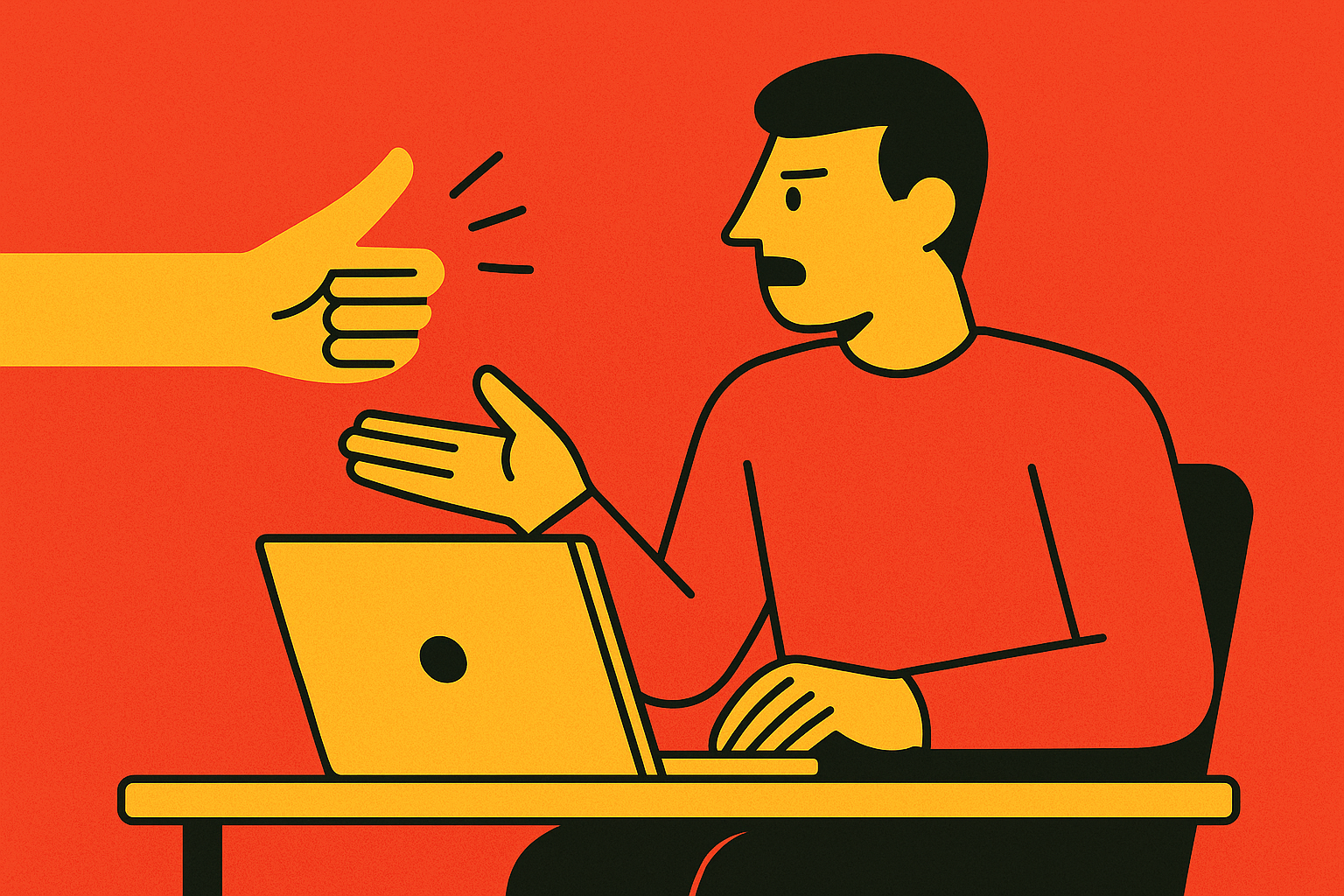
Being cut off mid-sentence produces a specific kind of disorientation. The point you were building collapses, the room's attention shifts to the interrupter, and the instinct is to read the interruption as proof that you were losing ground. That instinct is backwards. An interruption is far more often evidence that the other person has run out of better options and is reacting from pressure. Understanding that distinction changes everything about how to respond in the moment.
Interruption is commonly a panic response. It happens when someone realizes they no longer control the direction of the conversation, and breaking your sentence is the only lever left to pull. The person talking over you is not landing a blow; he is flinching. If the reflexive read, that the one doing the interrupting must hold the stronger position, were accurate, there would be no reason for anyone to resort to it. Arguers who are confident they can answer you when you finish generally let you finish. The ones who interrupt are frequently the ones who cannot afford to let your sentence reach its conclusion, because they suspect they have no answer for where it is headed.
This reframe carries a practical consequence that matters more than the psychological insight itself. Once you treat an interruption as a sign of the other person's pressure rather than your own weakness, you stop scrambling to recover and start absorbing the interruption calmly. The arguer who can hold that frame under real conditions, not just understand it as a concept, gains a durable advantage in any exchange where turns are not formally protected.
What formal debate formats have solved
Competitive debate treats interruption as a problem serious enough to legislate against. In high school and college tournaments across the country, cutting off the speaker is considered such bad form that it costs the interrupter speaker points, and repeated violations can cost the round itself. That penalty exists because tournament organizers long ago recognized what happens to the quality of argument when speakers can be shut down mid-thought: the exchange degrades into a contest of volume and timing rather than reasoning. Formal debate solves this by having judges and rules carry the enforcement burden, so no individual speaker has to defend the floor alone.
Outside the tournament room, that enforcement vanishes. Meetings, dinner-table disagreements, live exchanges on a call or in a comment thread all lack a moderator who deducts points for talking over someone. Turn order has to be self-enforced, and self-enforcement under social pressure is a fundamentally different skill than following a rule that someone else polices. The rest of this piece exists because that gap is the actual terrain most arguers operate in: no scoreboard, no judge, just the two people in the room and whatever composure each can hold onto.
How interruptions carry unequal costs
Interruption does not land the same way on every speaker. Some arguers face it more often, and when it happens to them, it costs more in perceived credibility than it would cost someone else making the identical point. That asymmetry raises the stakes for having a practiced response. If recovering the floor matters more for some speakers than others, then treating floor-recovery as optional, something you either have a knack for or don't, stops being a reasonable position. It becomes a skill worth deliberate practice precisely because the cost of having no response is not evenly distributed. None of this makes the problem insurmountable. It makes the tactics that follow more necessary, not less, for exactly the arguers who need them most.
Before an interruption happens: how to make yourself harder to cut off
The most reliable way to avoid being interrupted is to prevent the conditions that invite it before you ever reach your point. Workplace consultant Laura Rose, cited in Inc., recommends stating the shape of your argument up front: telling the room, "There are a lot of different pieces to this explanation, so please bear with me," and adding that you will want the other person's input once you've finished. That single move does two things at once. It signals that a pause in your delivery is not an opening but a mid-argument breath, and it gives the listener an explicit reason to hold their point rather than blurt it out the moment they think of it.
Structured classroom debate achieves the same effect institutionally, with rules such as "speak in turn, no interruptions" posted before the round begins so that everyone has agreed to the contract in advance. Informal settings require you to build that contract yourself, out loud, in real time. Signposting serves a related function: numbering your points aloud, first, second, third, gives listeners a structure to follow and makes clear that more is coming. Cutting in on a numbered list looks worse to anyone watching than cutting in on an unstructured ramble. The numbering itself offers a layer of protection.
In the moment: how to reclaim the floor without becoming the aggressor
When prevention fails and the interruption lands anyway, the goal is to recover the floor without matching the interrupter's aggression, because escalating damages your credibility faster than it damages theirs. The calmest tool is also the most direct: raise a hand, palm out, and say, "Let me finish." If the interruption continues, look away instead of raising your voice; disengaging eye contact removes the audience the interrupter may be performing for, and most interruptions lose energy once the performance has no one watching it.
A second approach works by acknowledgment and redirect. Stop talking, listen briefly to what the other person is saying, ask one clarifying question, and then lead the conversation firmly back to your original point. To anyone observing the exchange, this reads as genuine interest in the issue rather than a turf fight over who gets to keep talking, and that distinction functions as a credibility advantage in itself.
A third option, sometimes called verbal chicken, means simply continuing to speak through the interruption without raising your hand or acknowledging it. It does sometimes work. But aggressive, talked-over exchanges tend to frustrate judges and onlookers alike, making the person who refuses to yield look less credible rather than more, so this belongs at the bottom of the list, used only when the gentler options have already failed. If you do win the floor this way, the move only pays off if you jump immediately to your strongest point, re-engaging the room's attention before it drifts elsewhere.
Across all three approaches the constraint is the same: stay calm, stay on topic, and don't take the interruption personally. The arguer who remains composed while the other side escalates reads as the more credible voice in the room, regardless of whose underlying point is actually stronger. In formal cross-examination specifically, the smarter play is often to use the structure rather than fight it directly, locking in concessions with phrasing like "So you agree X, correct?" Judges in those settings tend to penalize a questioner who interrupts constantly. Restraint is rewarded by the format itself.
After the interruption: picking up the argument where it was strongest
Recovering the floor accomplishes nothing if the sentence that follows is a weak one. The arguer who returns to the strongest point in the case, instead of picking up wherever the interruption happened to land, turns the disruption into a net advantage. That requires jumping straight to the strongest point the moment the interrupter stops talking, catching the room's attention while it is still available.
Executing that move requires knowing, before the exchange ever starts, which point in your case is strongest. An arguer who has not mapped the hierarchy of their own argument in advance cannot make that decision under pressure; there is no time to sort through priorities once the floor has just been reclaimed. In competitive formats, an argument that goes unanswered is difficult for an opponent to beat. If the interruption caused a line of reasoning to drop, the moment right after recovery is the moment to state it again explicitly. Beginners often treat the post-interruption moment as a reset and start over from the top of their argument. Arguers who have internalized their own structure treat it as a continuation instead, picking the thread back up exactly where it was strongest. Whether a clear mental map of the argument existed before the interruption ever happened determines which of the two plays out.
Why this skill requires a real opponent to develop
Everything described above is simple to state and difficult to execute, because handling interruption without losing your thread is a performance skill, and performance skills degrade under pressure at the exact moment they are needed most. Reading about the hand-up gesture or the acknowledgment-and-redirect technique is not the same as producing either one while someone is actively talking over you with a room watching. That gap has to be closed through training against live opposition, not through further reading.
Beginners sometimes shut down entirely after a rough crossfire exchange or a dropped argument, treating the moment as though the round is already lost. Judges in competitive settings reward the opposite instinct: resilience under pressure, the ability to keep building a case after taking a real hit. That resilience is not something an arguer simply has or lacks; it gets built through repetition under conditions that actually resemble the pressure of the real exchange.
This is why debate practice resembles chess training far more than it resembles classroom discussion. Chess players do not improve by reading about openings; they improve by playing opponents who are actively trying to beat them, because the pressure of a real opponent produces decisions that a solved puzzle never demands. The obvious objection is that a friend willing to practice interrupting you should be enough. It isn't, because a cooperative partner pulls punches. The interrupter in a real exchange is motivated to win, and that motivation generates the pressure the technique has to survive. Practicing against someone who is only pretending to apply pressure trains the wrong reflex.
How to build a practice habit that puts you under pressure
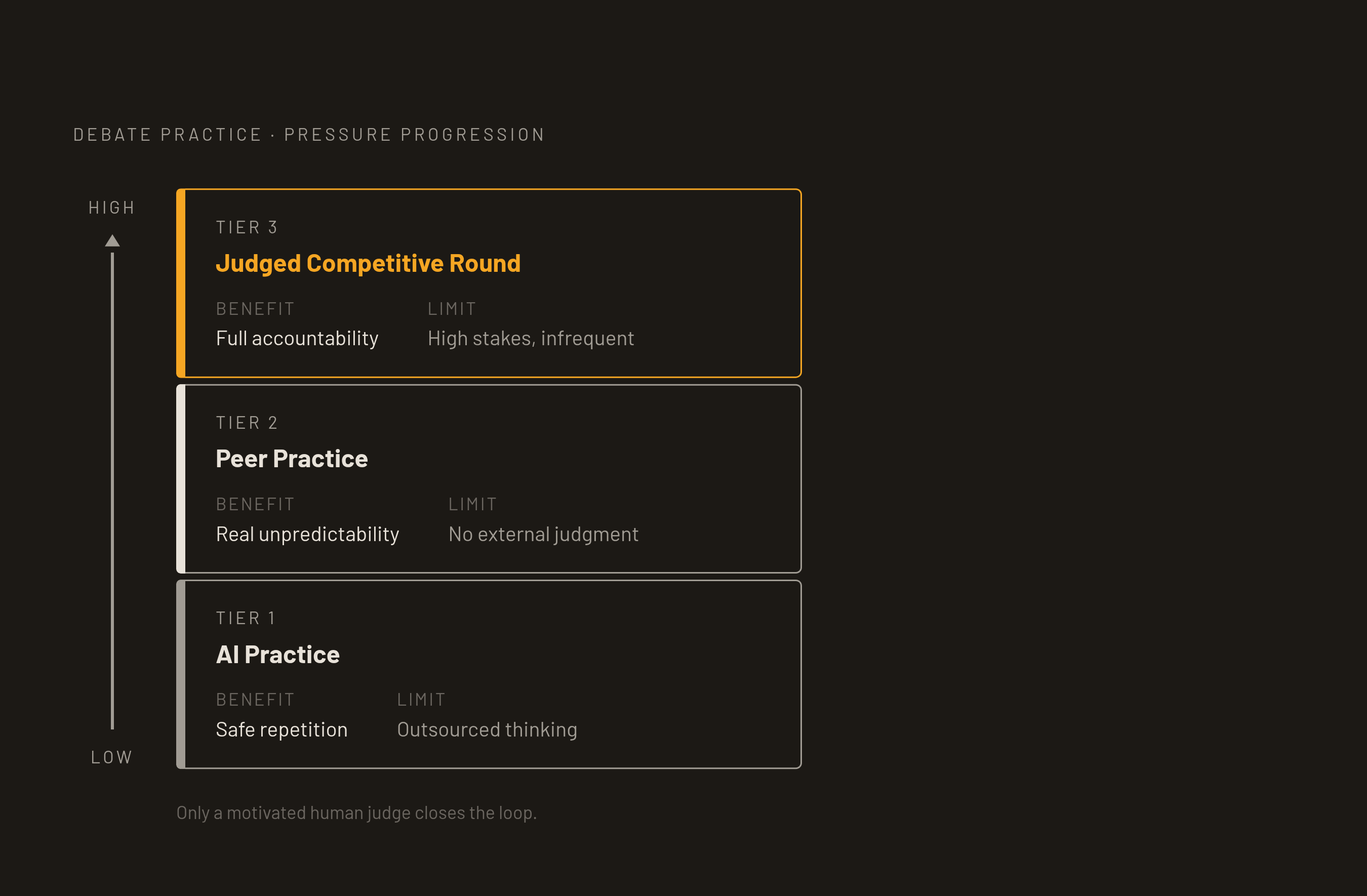
Building this skill requires a practice ecosystem with a few distinct tiers, and the right entry point depends on how much pressure an arguer is ready to absorb. All three tiers beat any amount of preparation that never involves a real back-and-forth exchange.
AI-based debate practice is the lowest-pressure tier. A technical AI debate setup typically assigns roles, one model proposes a position, another challenges it, and a judge (human, model, or scoring process) evaluates the result, which makes it a useful tool for rehearsing structure and getting comfortable with the basic shape of claim, rebuttal, and response. Research on AI conversational agents has found they reduce situational speaking anxiety in paired practice and presentation tasks, which lowers the barrier for a novice arguer to get started. But research on AI dependency also documents a real risk: a pattern researchers call a negative sequential pathway, where leaning on AI assistance correlates with weaker critical thinking, because the analytical work of building and defending a case gets outsourced. AI rounds function as training wheels. They build familiarity with structure and lower the barrier to starting, but they do not replicate the unpredictability of a motivated human who actually wants to beat you.
Peer practice with other arguers forms the middle tier, offering real unpredictability without the full weight of tournament stakes. Judged competitive rounds are the top tier, where scoring rules are published before the round begins, so the arguer knows in advance what reclaiming the floor needs to accomplish and knows that a judge, not a cooperative partner, will be the one deciding whether it worked. Moving up through these tiers, from AI-assisted rehearsal to peer exchange to judged competition, is what turns the tactics described above from concepts an arguer understands into reflexes an arguer can actually produce under real pressure.
Sources
- Antiti Conducting a Debate TN 13
- AI Debate: How It Works, Uses, and Limitations
- OLCreate: TESSA_RW Module 1 : Reading and writing for a range of purposes: Resource 4: Rules and procedures for debating
- Gender, Race, and Interruptions at Supreme Court Confirmation Hearings
- The Effect of Gender on Interruptions at Congressional Hearings