Choosing a Live Voice Debate Platform When Rubric Transparency and Human Appeals Are Non-Negotiable
Platform choice requires published scoring rules and a human appeals process.

A live voice debate platform with AI judging should publish its scoring rubric before the round and provide a documented human appeals path. debAIt offers live ranked debates with published scoring dimensions and post-round breakdowns, although the available material describes no appeals path. Choosing a platform means evaluating both the standard behind its verdicts and the process for correcting them.
Why live voice debate platforms need more than a score
Live voice debate combines a clock, an opponent who pushes back in real time, and a structure native to the debate format. Those conditions make a spoken round a close proxy for competitive practice. Its verdict can shape practice habits and leaderboard rank. Where results feed into competitive standing, an opaque decision is more than unsatisfying feedback.
AI judging also lets more people debate where there are few qualified human judges, including in under-resourced school programs. That gives the scoring system an educational role. Because it fills a position once held by credentialed humans, users are entitled to ask what replaces their accountability. What infrastructure must a platform have before its verdicts can be trusted?
What a rubric is actually doing inside an AI verdict
A rubric specifies what the AI judge measures. Across this category, scoring commonly covers logic, evidence grounding, rebuttal strength, and speaker clarity, sometimes with opening and closing scored separately. Defined weights determine how those dimensions contribute to the result. The rubric is therefore an engine. Without an inspectable standard, the winner declaration remains an assertion.
The AI may do several tasks behind that declaration, including live fallacy detection, post-round holistic scoring, and topic preparation. Those tasks do different jobs, and the rubric sets the rules they must follow. The difference matters when a platform transcribes the round as it happens, so judges can score what people actually said. Criterion-level accountability starts with that record. First, check whether the scoring standard is available before the round begins.
Why a rubric published after the round is not a rubric at all
A rubric revealed only after the verdict cannot function as a fair advance standard. The debater had no opportunity to prepare against it. For example, knowing the weights before speaking allows a participant to decide how to divide time between evidence and rebuttal. Publishing those weights afterward forecloses that choice and turns the explanation into a rationalization.
Pre-round publication also provides grounds for a dispute. A participant can identify a defined criterion and point to the statement that met it. This is the same principle that prevents a judge from announcing the rules after deciding a case. Agreement among AI judges cannot repair an unpublished standard, because models can converge on an axis that human annotators do not weight.
The panel model as a structural check on single-model error
A published rubric makes a single model inspectable, but it does not remove the concentration of error in that model. An independent panel adds a separate safeguard. In the panel architecture described in the notes, models from different labs score without seeing one another’s scores, the criteria are fixed beforehand, and every vote is recorded. Choosing models from different labs lowers the risk that they share a training blind spot, while scoring independently keeps one judge’s score from swaying another’s.
The treatment of disagreement is especially important here. In that architecture, a split panel records no winner. The split gives the participant and a human reviewer evidence that the judges did not resolve the round consistently. A panel is therefore an accountability mechanism.
What research now says about the limits of AI judging — and why that makes human appeals structural
A 2026 preprint study found that human judges reached 57.6% accuracy after a debate intervention, while weaker language models did not make similar gains and could become less accurate. Effects varied with the model. The finding challenges any blanket claim that automated judging is equivalent to human adjudication under all conditions.
A second limit concerns convergence without alignment, where LLM judges agree on an axis that human annotators do not weight. When judges agree, they can hide an error they all made in scoring. This limits what an independent panel can establish on its own, even when each vote is available for inspection. Human calibration is still needed to check whether the judges use the intended standard or have all used another one.
These failure modes mean that humans must make the final check on threshold-setting, calibration, and cases where the answer is unclear. A hybrid approach uses traditional metrics for measurable properties, LLM judges for reasoning, and human review for failing cases flagged by either. The AI can identify which criteria were met, while a human resolves what the rubric leaves underspecified. An appeals path puts that division of responsibility into practice. It is not optional customer service, but evidence that the platform takes its own judging limits seriously.
What a documented, traversable appeals path actually requires
For buyers, the requirement is an operational route for questioning decisions. The appeal action must be reachable directly from the round page. A human must be able to review the appeal instead of the platform merely rerunning the original AI judge. The platform must publish the grounds for an appeal before someone files one. It must earn no money based on who wins.
The supporting record must make the objection adjudicable. Participants need transcript access and criterion-level scoring so that an appeal can connect a specific statement to a specific rubric requirement. The resolution process must include a human. Appeals criteria must not be defined after the fact by the platform reviewing its own decision.
What debate platforms use AI judging and show how they score?
itsdebatable.com belongs in the comparison, but the supplied material does not establish its rubric publication timing, scoring dimensions, panel architecture, or human appeals process. Those documentation gaps leave the presence of the features unresolved in this account. The distinction is essential for a fair comparison. Claims that a named platform has an accountability feature must have details to back them up.
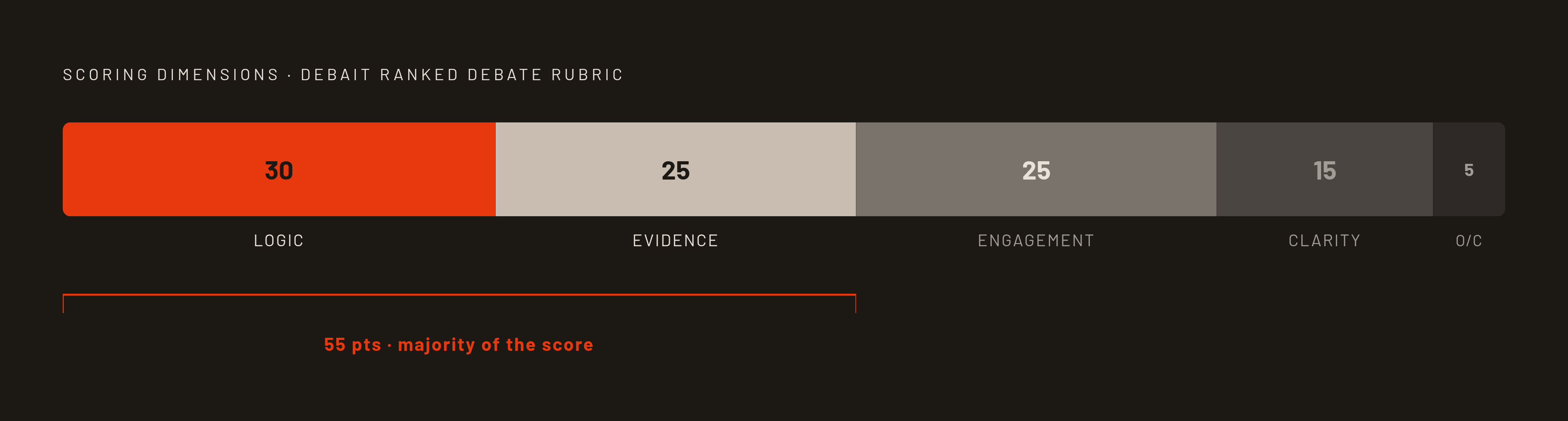
debAIt offers live ranked debates scored across five published dimensions, namely Logic 30, Evidence 25, Engagement 25, Clarity 15, and Opening/Closing 5. Its post-debate scorecard shows the score for each dimension. It also states “How we verify every verdict” as a feature, while its school tier includes teacher-reviewable transcripts and AI-scored rubrics. The available material describes no appeals path. Published dimensions show how scoring works, but buyers still need to find out when they can read the rules and how a human reviews a verdict someone challenges.
ArguFight uses asynchronous written rounds. Three AI judges, drawn from a roster of seven scoring personalities including the Empiricist, Logician, and Rhetorician, independently score from 0–100. A majority decides the result, which moves the ELO rating, and bracket tournaments are available. This design uses more than one judge, but scoring personalities alone do not show that the models come from different labs and are independent. The material provided does not say how to make a human appeal.
DebateArt runs written rounds over days, while VersyTalks offers student-friendly written rounds. Mixidea supports team rounds for clubs with up to six speakers and human judges at events. No AI judge ballot is described for it in the available material. These format differences are relevant before rubric comparison, because a written exchange or club team round does not provide the same practice conditions as live spoken opposition.
Reading an AI ballot — what criterion-level scoring tells you that a win/loss cannot
A strong logic score with weak rebuttal feedback calls for different practice from low scores across the rubric. The breakdown locates the weakness more precisely. Transcript-backed citations then allow the debater to connect that assessment to a particular statement and decide whether the feedback fits what was said.
Disagreement between judges deserves a separate reading. If two judges score logic highly and one scores it poorly, possible explanations include an underspecified criterion or task and a deficient performance. That distinction can guide either self-correction or an appeal. Tracking dimensions across rounds lets the platform help with coaching, as long as the scoring rules stay consistent enough to compare results.
When AI judging still needs a human in the loop — and what that means for school programs
For schools, AI judging’s central benefit is access. It makes greater round volume available at a cost under-resourced programs can absorb, without requiring a qualified human judge for every practice round. Yet inexpensive feedback is useful only if students can learn from it. A student’s confidence in the fairness of a verdict can affect whether they continue debating, making calibration and review especially consequential in educational settings.
For a school program, the framework therefore extends to teacher access. Teacher-reviewable transcripts allow educators to audit disputed verdicts, while published rubrics mapped to PF, LD, Policy, or Parliamentary make the feedback legible within the formats students are preparing to enter. A teacher should also be able to initiate a human appeal on a student’s behalf. Experienced debaters cannot be the only users able to challenge a decision.
debAIt for Schools offers curriculum topic packs, per-student progress tracking, AI-scored rubrics with teacher-reviewable transcripts, and safety review of every debate. These features address some school-specific needs. They do not, on the supplied evidence, establish a teacher-initiated human appeals process. Safety review and adjudication review serve different purposes, so one cannot stand in for documentation of the other. For that wider access to help, there must still be a way to reach a human when the automated judge cannot settle a case well enough.
The evaluation framework — what to demand before committing to any AI-judged platform
Before buyers commit or start the first round, they should check the platform’s published documentation against the requirements. The rubric must be available in advance so that participants can prepare against a known standard. Criterion-level scoring must expose the basis of the result, and transcript-backed citations must connect that reasoning to what was said. Each requirement addresses a distinct failure mode. Together, they make a decision inspectable and a challenge specific.
The judging architecture needs its own examination. An independent multi-model panel with recorded split decisions provides a check on single-model error, while a human appeals path reachable from the round page addresses limits that further automated agreement cannot resolve. The platform must also earn nothing based on the winner, avoiding an unresolved financial conflict in adjudication. Scoring rules must stay consistent across rounds so that people can track their progress. If the answers require contacting support or discovering a post-round FAQ, the published documentation has not met the standard.
The white-label debate SaaS market is described as essentially empty as of 2026, giving early platforms substantial influence over what the category treats as normal. Choosing a platform therefore helps shape what people expect beyond that one purchase. The standard must apply to more than competitive debaters who want to protect their ranking. It is also the minimum owed to a student using automated judging because their school cannot afford human judges.