Overlapping Speech and Simultaneous Talking in Debate Rounds
Overlapping speech is a learnable skill, not a flaw to eliminate.
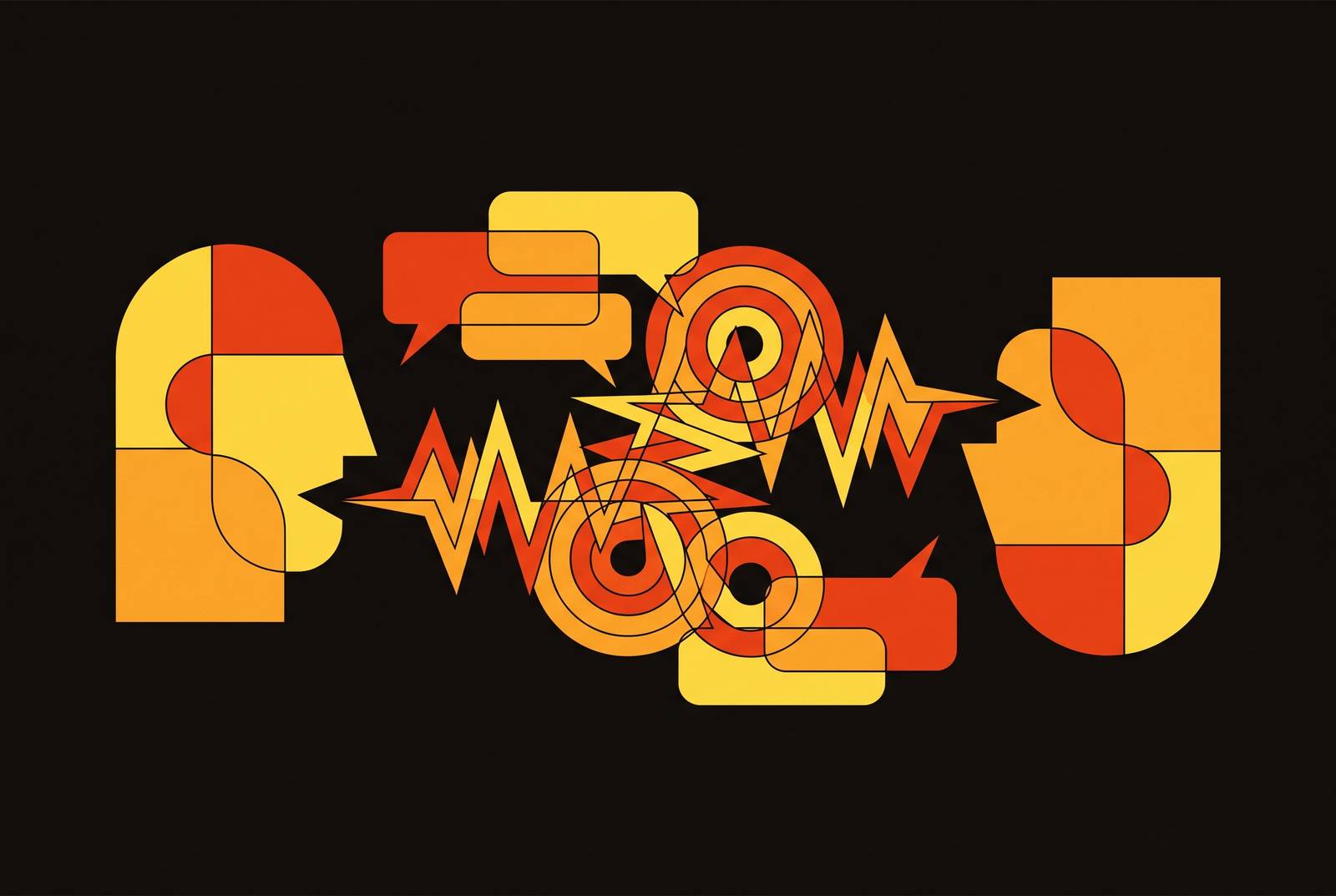
Overlapping speech in a debate round is a predictable feature of any format that puts two or more trained speakers under a clock and asks them to win the same three minutes.
Overlapping Speech as a Permanent Feature of Competitive Debate Rounds
Two speakers trying to occupy the same stretch of time will, under enough pressure, try to occupy it at once. Researchers studying conversation describe this as serious, sustained, competitive simultaneous talk by more than two parties seeking to occupy the same turn space, and that description fits a debate round better than it fits almost any other setting where people speak for a living. A debate round is built to produce exactly this condition: two sides, a clock, and a shared understanding that the person speaking at any given moment has something the other side wants. Formats do not treat this as an accident to be trained out of existence. World Schools debate builds a Point of Information directly into the rules, letting one debater interrupt another mid-speech under a defined procedure. That single rule tells you how debate as an institution actually regards overlap: not as a breakdown to be apologized for, but as a skill with its own etiquette, timing, and reward structure.
Types of simultaneous talk
Not all overlapping speech does the same job, and treating it as one undifferentiated category is where most debaters go wrong. A short "yeah" or "mm-hmm" dropped into an opponent's speech is a backchannel. It is not an attempt to take the floor at all, and a debater who stops to address it has mistaken a nod for a tackle. A failed interruption looks more aggressive. Someone tries to break in, the original speaker keeps talking, and the interruption dies without ever taking control of the turn. That exchange is already decided in the first speaker's favor the moment they keep their rhythm. A successful interruption is the real event: the interrupter seizes the floor while the first speaker's sentence is still running, putting the first speaker in a reacting position. Then there is cooperative overlap, engagement meant to signal agreement or to finish a partner's point along with them, and this is the category judges disagree about most. What one judging panel reads as two debaters building on each other, another reads as one debater steamrolling a partner, and that disagreement tracks the judge's own conversational habits as much as it tracks what happened in the round. A debater who cannot tell a backchannel from a floor grab ends up fighting the wrong battle twice: wasting energy defending against sounds that were never a threat, and failing to notice the interruption that actually took the turn away.
Overlapping speech in debate rounds
Holding the floor and winning the exchange in a judge's mind are two different accomplishments, and debaters who confuse them lose rounds they technically should have won. Listeners tend to perceive a speaker as interrupting when the overlap runs long and comes paired with a louder voice and a faster rate of speech, and that perception shifts depending on the listener's own habits in conversation. A speaker who successfully breaks into another speaker's turn typically raises pitch and volume above their own normal conversational level, and pitch and volume together do most of the work that lets a listener register one voice as having taken over from another. Loud, fast talk reads as competitive and even confident when two people are actually talking over each other, but the instant one speaker is talking alone, that same volume reads as anger or coarseness. A debater who wins the floor by shouting over an opponent often pays for it in the score, since the win registers as aggression. The disagreement over cooperative overlap is a live scoring risk, not a classroom curiosity: a judge whose own conversational norms treat talking over someone as engagement will score an exchange one way, and a judge who hears the same exchange as disrespectful will score it the opposite way. How a debater sounds in the moment of overlap, not simply whether they end up holding the floor, is itself a variable the judge is weighing. Treating the contest as purely mechanical, a matter of who talked last, misses the half of the equation that actually decides the number on the ballot.
The structural access problem: debaters who lose arguments because of floor control, not logic
Floor control is a trainable skill, and its absence in a given debater says nothing about the strength of that debater's arguments. In fast, multi-speaker formats, turn-taking opportunities shrink and participation gets uneven, so a debater who cannot secure a turn loses the chance to put an argument on the record, a separate failure from having made a weak argument. Grand Crossfire in Public Forum, where all four debaters argue at once for three minutes, is the clearest version of this problem. A debater walking into that round without prior experience managing simultaneous, multi-party talk is walking into real chaos with no procedural safety net, since nothing in the format slows down for someone encountering it for the first time. Debaters coming from programs with consistent, well-resourced coaching tend to have drilled crossfire management specifically, while debaters without that coaching meet the format cold, often for the first time, at an actual tournament. The obvious objection is that skilled debaters find a way through regardless of the chaos. That is true on average, but the distribution of who struggles and who does not is not random. It tracks access to practice partners and coaching time, a correlation that points to the structural problem. A training environment that replicates genuine competitive overlap, not just orderly turn-taking in a calm conversation, has a different value than ordinary classroom discussion, because it is the only kind of practice that actually puts a debater in the condition the tournament will.
The core tactics for managing each type of overlap in real time
Each category of overlap has a response that fits it, and the cost of using the wrong one is close to the cost of having no response. Against a backchannel, the correct move is to keep going. Breaking stride to acknowledge a "mm-hmm" hands over more ground than the backchannel ever threatened to take. Against a failed interruption, the speaker who is already holding the floor should raise volume briefly at the exact point of overlap, finish the sentence at the same pace, and move straight to the next point. Since that exchange is already won, lingering on it only costs rhythm. Successful interruptions call for prevention over reaction: ending sentences on a rising pattern instead of trailing off, and placing the most important word late in the clause so an opponent has no obvious gap to step into. Once the floor is actually lost, re-entering with a short, direct question works better than trying to out-volume the interrupter. Pitch and volume should rise enough, at the moment of contest, to signal that the floor is being fought for, then drop back to a normal register once the exchange is settled. A speaker who returns to a measured tone after winning a turn reads as composed; a speaker who stays loud reads as rattled, even while winning. In Grand Crossfire specifically, the debaters who hold the floor most effectively tend to use a named address, something like "My opponent said," to reanchor the round rather than trying to shout over three other people at once. That phrase creates a short pause that functions as a reset for everyone in the exchange. In World Schools Points of Information, the debater who is speaking controls the frame by choosing when to accept. Accepting one POI and handling it with composure reads as stronger than refusing every one, since a pattern of refusal tends to signal anxiety about losing control of the floor.
Why practicing overlap requires a real opponent
Managing overlap is a reactive, real-time skill, and no amount of reading about it substitutes for practicing it against someone who is actually trying to take the floor. Classroom discussion, essay writing, and structured turn-taking exercises all leave out the one variable that defines the skill: an opponent who wants the same turn and has something riding on winning it. The closest analogy is chess training. Learning an opening by yourself does not prepare you for the moment a strong opponent plays something you did not expect, and the same is true of overlap management drilled without resistance. A setting where real people debate live, under a clock, in front of a judge who records a score, adds the one ingredient that solo drilling cannot fake: the knowledge that someone is evaluating the exchange as it happens, which changes how both sides actually compete for the floor. The obvious response is that tournaments already provide this kind of practice. They do, but they are infrequent and high-stakes, and what a debater actually needs is a low-barrier setting with enough repetition to make mistakes in overlap management without those mistakes going on a tournament record. Daily access to live practice rounds is what closes that gap, not another lecture on technique.
Reading an AI judging decision that mentions your floor control
A scored decision only helps a debater improve overlap management if two conditions hold: the rubric was public before the round started, and the decision cites specific moments from the actual exchange. Without both, there is no way to connect a score to a particular choice made in a particular crossfire. AI judging offers one advantage human judging cannot match on its own, which is consistency: the same rubric gets applied every time, so a debater who changes one specific habit across several rounds gets a clean read on whether that change moved the number. AI judging also tends to be more transparent about its reasoning. Where a human judge might write "good energy in crossfire" and leave it there, an AI judge can specify that a given exchange was handled with composure, or that a particular response came across as unclear under pressure, tying the score to a named moment. Human judges hold an edge in adaptability: a human can recognize when a debater is running an advanced rhetorical device or deliberately arguing a position they don't hold, while an AI judge can sometimes misread a deliberate pause or a named-address reset as passivity. A 2025 study posted to arXiv found that AI judges built with human-like personas reached 78.5% accuracy, outperforming both human judges and default AI judges that had no persona. The lesson for a debater is that the specific judge engine's persona and rubric design shape what floor-control behavior actually gets rewarded, so the same tactic can score differently depending on which system is judging. When a decision comes back with feedback on floor control, the response quality and clarity scores carry more diagnostic value than the logic score alone. A dropped argument lowers the logic score. A muddled, overlapping exchange lowers the clarity or response-quality score. Checking which of those two scores actually fell tells a debater which kind of overlap problem caused the loss, and that is the detail to act on before the next round.