Solo AI Opponent Rounds as a Daily Debate Practice Habit
A structured AI opponent routine for daily solo debate practice.

A solo AI debate opponent makes daily practice without a partner possible by supplying an opposing case whenever the debater is ready. The effective habit combines structured rounds, deliberate side switching, and written feedback in regular practice. AI makes frequent practice possible, while human rounds remain necessary for competitive pressure and the interpersonal demands of debate.
Why consistent debate practice is hard to get, and what that costs a developing debater
Serious practice depends on more than a willing learner. It requires an opponent who is available, prepared on the same topic, and able to respond to the case actually presented. Club meetings happen once a week, tournament preparation is seasonal, and finding a prepared partner available on the same morning depends on coincidence. Access is the bottleneck. So learners practice in bursts and have fewer chances to fix a weakness while it is still clear.
PolyDebate identifies a broader supply problem in providing high-quality debate practice at scale. Learners need a responsive opponent, a clear procedure, and formative feedback on argument quality and oral delivery, yet those elements are rarely available together. Repetition needs all three to become directed practice. Argument construction, rebuttal, and evidence-weighting require drilling, while gaps between rounds interrupt the incremental feedback loop. A developing debater thus needs a way to practice without depending on another person’s calendar.
How can you practice debate every day without a partner?
An AI opponent can provide the responsive opposition that makes solo practice more than rehearsing a prepared speech. PolyDebate’s literature review describes AI debaters that retrieve evidence, generate arguments, and sustain multi-turn interactions. Those functions preserve the core exchange of a practice round. The learner advances a case, encounters objections, and must answer them. Availability removes the scheduling constraint without removing that argumentative demand.
Topic flexibility also changes what can be practiced. A debater can work on autonomous AI hiring decisions on Monday and phones in schools on Tuesday without locating a partner prepared for either. The opposing case can expose arguments the learner would not have generated alone, making opposition itself a training input. When choosing a tool, look for multi-turn argument that responds to the case, rounds with a clear structure, and feedback that explains its reasons. Generating a persuasive opening is not enough.
An AI does not get emotional, bluff, or apply rhetorical pressure in the same way a human opponent does, and it has no ego investment in winning. Competitive stakes are absent from the exchange. The appropriate role is argument development and repetition volume, with human rounds supplying the interpersonal pressure that solo work cannot fully reproduce.
What a single productive solo session actually looks like, step by step
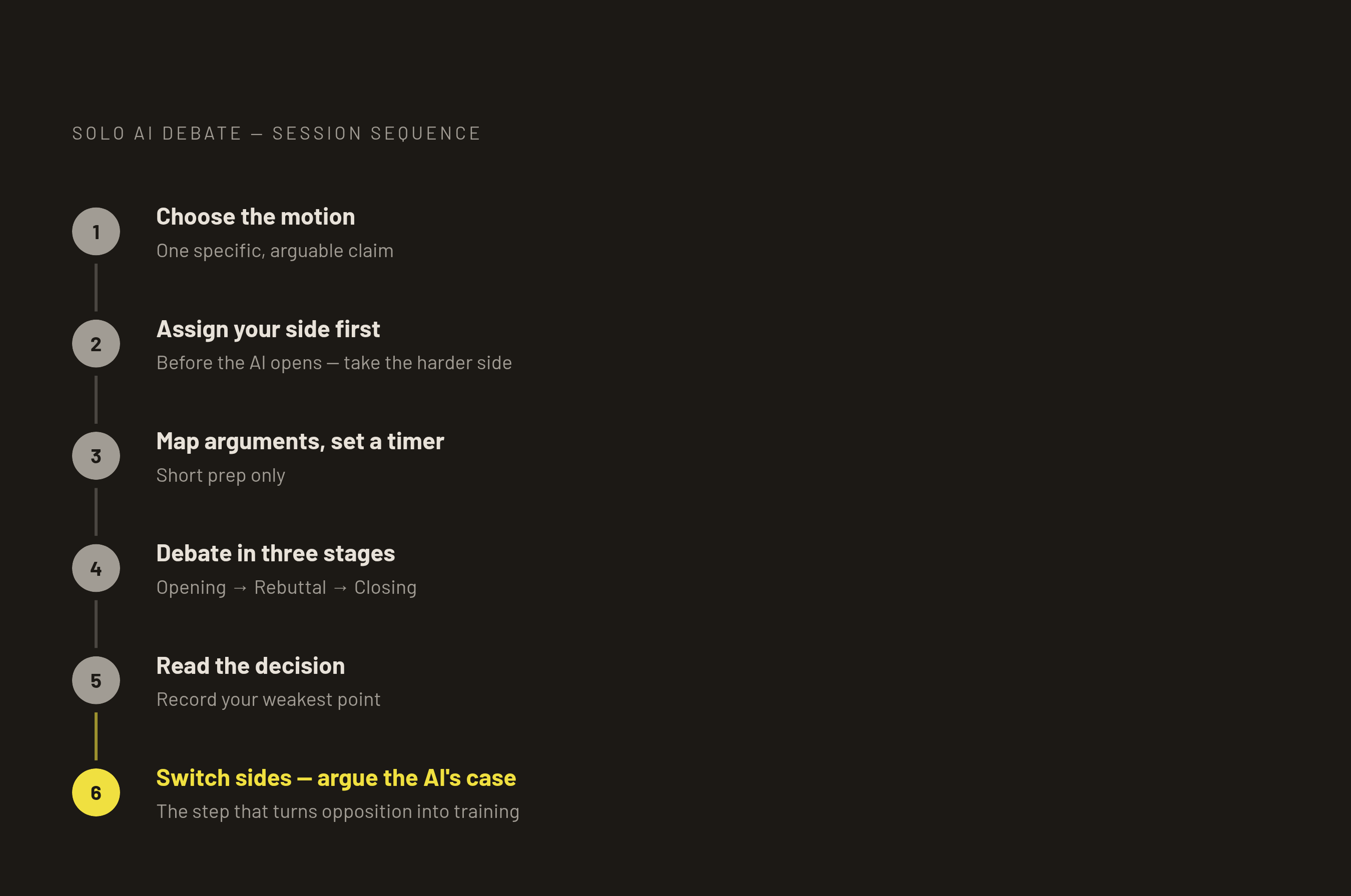
For solo practice, follow a set of steps that can be repeated instead of letting the conversation run without a plan. Begin with one specific, arguable motion, then assign sides before seeing the AI’s opening. Choose the harder side when possible. Tipping, remote work, or salary transparency can provide useful subject matter, but each needs a proposition that can be defended or rejected. When the topic is vague, the burden of proof is vague too.
Next, set a time limit to prepare a short argument map that shows where each piece of evidence fits. This separates the claim from its support before speaking begins and gives the round a logical structure to test. Then proceed through an opening statement, a rebuttal to the AI’s case, and a closing. Keep the stages distinct from one another. PolyDebate formalizes this procedural control through side assignment, stage control, and speaking turns.
For timed speaking, allow two to three minutes per stage. The clock forces choices about which objection deserves an answer and which argument deserves space in the close. After the round, read beyond the verdict to the written decision’s reasoning and record the weakest point it names. Finally, take the AI’s side and argue it, so that recognizing an opposing argument becomes the harder task of constructing it.
Which skills each session sharpens, and how to match session design to a specific weakness
The useful adjustment is the constraint placed on the skill under examination, whether that is rebuttal speed, evidence quality, argument mapping, or burden management. To get faster at rebuttal, keep the speaking clock and spend the session working on answers to the AI’s case. To work on argument construction, use PREP, which stands for Point-Reason-Example-Point, for each opening argument. The structure forces a complete logical unit within a short window, making it harder to substitute an assertion for a supported case.
To practice steelmanning, write the strongest opposing case before writing your own. This changes the preparation task from collecting reasons for a preferred view to identifying what a serious opponent could defend. Answering a weakened caricature leaves the strongest objection untouched, while engaging the best opposing argument builds credibility. The subsequent round tests whether the response survives that stronger formulation.
Policy rounds require a different constraint. Track the five stock issues through the exchange, namely Inherency, Harms, Significance, Solvency, and Topicality, with Harms and Significance often treated together. A missing issue can be a loss condition in competitive policy debate, so a strong individual argument does not remove the need to meet the other burdens. For framing practice, define the central question before presenting the case. That opening establishes the terms the opponent must address, making the definition of the dispute part of the exercise.
How to choose topics that make daily sessions more productive over time
Everyday dilemmas provide familiar ground on which a learner already has intuitions, while policy resolutions require an account of an existing problem and a proposed remedy. Comfortable subjects are useful, but not sufficient. A debater who repeatedly chooses the same kind of case can become practiced at that case without addressing weaknesses elsewhere. The practical rotation is to alternate an easier topic with a harder one.
For early sessions or warm-ups, familiar topics such as tipping norms, canceled plans, and phones in schools allow attention to remain on structure. Relationship and everyday dilemmas can also make a structured exchange approachable for newcomers. These familiar subjects require reasons, responses to objections, and a defensible account of why one consideration should outweigh another.
Policy resolutions add explicit burdens. “The U.S. federal government should ban autonomous AI hiring decisions” requires an account of persistent bias, discriminatory outcomes, whether a ban reduces them, and what counts as autonomous. The controversy supplies a substantive clash. Algorithmic hiring can be defended as auditable for bias in ways human interviewers cannot be, while the opposing case is that a model trained on past hires inherits historical prejudice behind an appearance of objectivity. Minnesota’s requirement, effective January 1, 2025, that employers with 30 or more employees include the starting salary range and a general description of benefits in job postings provides another concrete basis for a policy round. Such topics move practice beyond abstract preferences into disputes over actual rules and stakeholder interests.
How written feedback from an AI judge creates the feedback loop that makes practice measurable
A written decision gives the completed round a use beyond the exchange itself. It should identify the crux, explain which argument turned the decision, and name the weakest point in the losing or less effective case. A bare verdict provides no repair instruction. By contrast, an explanation that identifies a failure of solvency gives the debater a specific burden to revisit. The next session can then test a correction.
PolyDebate’s evaluation module produces stage-level and overall feedback linked to a rubric. Stage-level assessment helps distinguish a weak opening from an inadequate rebuttal or an ineffective close, which identifies more precisely what needs practice. The location of the weakness changes the response. A case that began clearly but failed to answer opposition calls for different practice from one that never established its claim. An overall score alone obscures that distinction.
To make this feedback useful over time, keep a running log of the weakest point named, the stock issue most often dropped, and the technique most often rewarded. Repeated criticism of solvency across sessions indicates a recurring weakness to investigate. Also predict the round’s crux before reading the decision. Agreement between that prediction and the judge’s reasoning can indicate awareness of where the clash occurred. The log then records both argument weaknesses and the debater’s ability to recognize them, giving later sessions a specific point of comparison.
What to know about AI judge reliability before treating its feedback as ground truth
Even strong LLM judges can tend to give higher or lower scores than human judges while often agreeing on how the debaters rank. Direction can be more useful than magnitude. A rising score does not, by itself, establish how much a debater has improved, and a flat score does not prove that improvement has stopped. Apparent plateaus may reflect judge error or limits in the measurement.
Several biases can distort the decision itself. Position bias gives an edge to the response listed first, while verbosity bias rewards an argument’s length regardless of its quality. Self-preference bias can inflate scores for outputs from the same model family. Format bias and calibration drift also make the results less certain. These are reasons to examine what a decision rewards, especially when praise appears attached to presentation rather than the argument’s response to the opposing case.
The practical posture is to treat feedback as one signal across many sessions. Interrogate the stated reasoning to evaluate the score. A repeated diagnosis is useful when it identifies a weakness that can be traced through the exchange, but repetition alone does not make the judge infallible. Likewise, a judging system that publishes its known failure modes offers a more rigorous basis for use than one that presents an unexplained score.
How to build the daily session into a sustainable habit rather than a streak that collapses
A demanding full round can be useful, but making it the minimum turns a daily habit into a recurring scheduling challenge. For sustainability, set a non-negotiable minimum small enough to complete, even if it is only a single timed rebuttal drill. A twenty-minute full round is the upper limit for a daily practice day. The shorter drill preserves continuity without pretending to be a complete round.
Before ending a session, make it easier to set up the next one. Pre-select its topic, then review the previous session’s weakest point before beginning the new exchange. That creates continuity without requiring a human coach. Keep the skill focus steady for a week rather than changing it every day, with rebuttal speed in week one, evidence quality in week two, and policy stock issues in week three. Changing topics adds variety, while working on the same skill gives the feedback a shared point of reference.
Competitive debaters can use solo rounds as morning warm-ups before club meetings or tournaments to test arguments when little is at stake and failure can help. Newcomers can begin with everyday topics and a single structured exchange before adding timed pressure or policy complexity. An unpopular or unfinished view can become useful practice when it is defended, challenged, and examined. The habit lasts when regular sessions, even imperfect ones, keep that feedback loop going instead of waiting for the rare session when everything is perfect.
Sources
- PolyDebate: A Game-Orchestrated Multimodal System for Debate Skills Practice and Evaluation
- The Judge is Part of the Experiment: Auditing Peer Context Sensitivity in LLM-Based Evaluation
- Benchmarking LLM Judges via Debate Speech Evaluation
- When AIs Judge AIs: The Rise of Agent-as-a-Judge Evaluation for LLMs